
About the
project
As market conditions began to change and the cost of capital began to rise, Clearco wanted to explore a new opportunity and address new market segments. The company has been in the business of offering equity-free capital to eCommerce founders. This model had been successful through the years and allowed the company to scale into different international markets. The company now wanted to build a fully automated invoice management and payment rails infrastructure that streamlined payments between eCommerce companies and vendors. The solution would also allow founders to maximize cash flow by allowing them to extend payments on existing invoices. The company saw an opportunity to reposition the existing core capital offering product into a new service that solved the critical problem of cash flow optimization.
Some reasons why Clearco decided to build the solution:
1.) Help Clearco access a greater share of the founder’s transactions.
2.) Establish confidence in their ability to manage payment processing, from the user experience through to the back office management.
2.) Grow payments towards profitable unit economics.
Challenge

Payments processing is a core business management problem facing founders operating eCommerce businesses. Early research and interviews have shown that small business owners are looking to improve the way they manage and pay invoices. Some are looking to optimize their cash flow, while others are looking to simplify complexity and find efficiency in processing. The challenge was to build a payments solution that scales with the founders, helping them manage and organize their invoices and aid them in distributing and spending their capital efficiently.
Part of the challenge was also to develop a path for founders to access additional capital when it was required for extending payment terms on invoices thereby building a “Buy now, Pay Later” for the customers.
The Vision Sprint
When we began to build the MVP for the payments project, we uncovered different problems to solve based on previous user research. At the time we had collaborated cross-functionally to build a lean canvas that would inform our initial hypothesis. We began running different experiments to test these hypotheses and quickly realized that a road map was critical to the team’s success. To discover which solutions to prioritize and inform our roadmap, we decided to run a vision sprint with all the stakeholders involved in the project.
This exercise aimed to produce a series of experiences/screens that would serve as a concept solution and a vision. In contrast to a sprint, this concept design/vision sprint would address a hypothesis and a set of problem statements we identify. A much broader scope was intended for the problem statements. This Sprint was intended to look 1, 6, and 12 months into the future and solve a broader range of problems.
Empathize
Define
Ideate
Prototype
Test
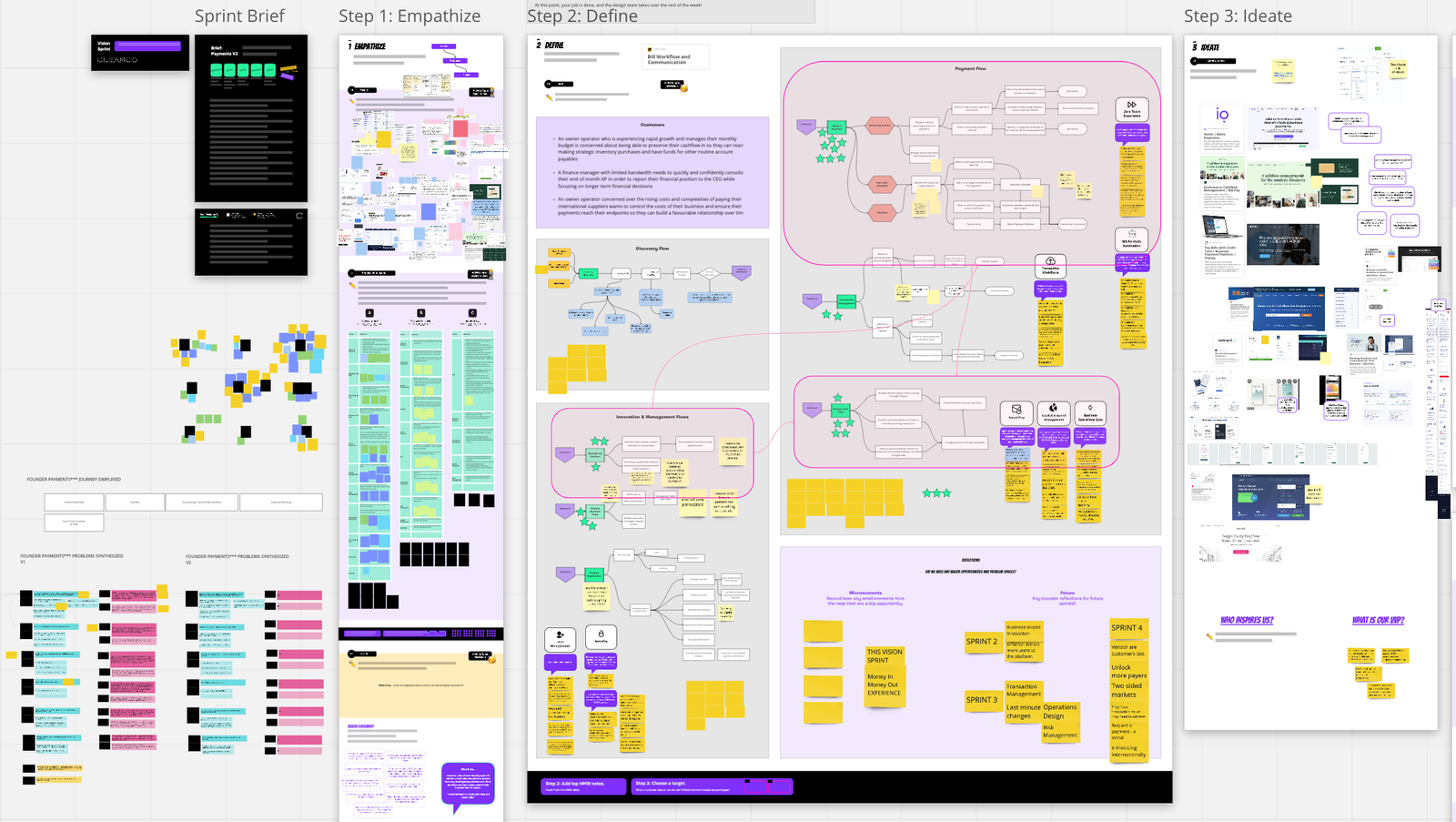
The Vision Sprint - Outcome
Problem & Hypothesis 1
- We believe if we create a centralized hub to track bills and payments or even take on and automate the tasks of collecting and paying bills themselves, this will provide Founders with a more consolidated and streamlined process for bill payments not found or comparable in market, thereby saving them time, reducing errors, and removing stress.
Problem & Hypothesis 2
- We believe if we automate wire payments and offer free or at least price-match FX rates, this will… provide Founders with a more streamlined and cheaper process for wire payments not found or comparable in market, thereby saving them time, reducing errors, and saving them money.
Problem & Hypothesis 3
- We believe if we offer payment instalments for purchase orders or “large” one-off bills, this will… provide Founders with the cash and freedom to finance these bills not otherwise available to them, thereby enabling them to grow their business AND provide Founders with a more convenient and comprehensible way to finance these bills vs. through our traditional MCA product.
Problem & Hypothesis 4
- We believe if we offer payment term flexibility in terms of # of instalments (ie. payment period), amount of each instalment, and payment method for each instalment, this will… provide some Founders with better repayment terms vs. with our traditional MCA product (ie. ultimately lower fees? thereby more positive/flexible cashflow?) AND with more liquidity to finance bills through a broader range of payment methods (ie. more flexible cashflow).
Problem & Hypothesis 5
- We believe if we provide confirmation when payments have arrived, this will… alleviate anxiety and assure Founders that payments have arrived successfully, allow them to feel more secure in their ability to maintain healthy vendor relationships, and increase trust in their finance team.
Problem & Hypothesis 6
- We believe if we provide a way to easily reconcile payments with a Founders’ accounting software, this will… provide Founders or their finance team with a more streamlined process for accounting, thereby saving them time, reducing errors, and removing stress.
Process: Dual-Track Agile Methodology
Since the product was new, we had to work on multiple problems in parallel, run discovery, monitor the performance of freshly released experiments, deliver assets to engineers and strategize the big picture.
During the design process, most of the time is spent discovering and thinking about the problem. The cost of solving the wrong problem is high. Iteration is also a constant process for designers. Before coming up with a final solution that goes to production, we experiment and try out dozens of alternative solutions. Most of them end up in junk, but the learnings are precious. Making mistakes during the design phase is much less expensive than after the product has been developed and released.
We scoped out the design work week and prioritized problems to solve based on our recent releases and iteration. This not only helped us move faster but also helped us align stakeholders while building an agile methodology to manage the product roadmap.
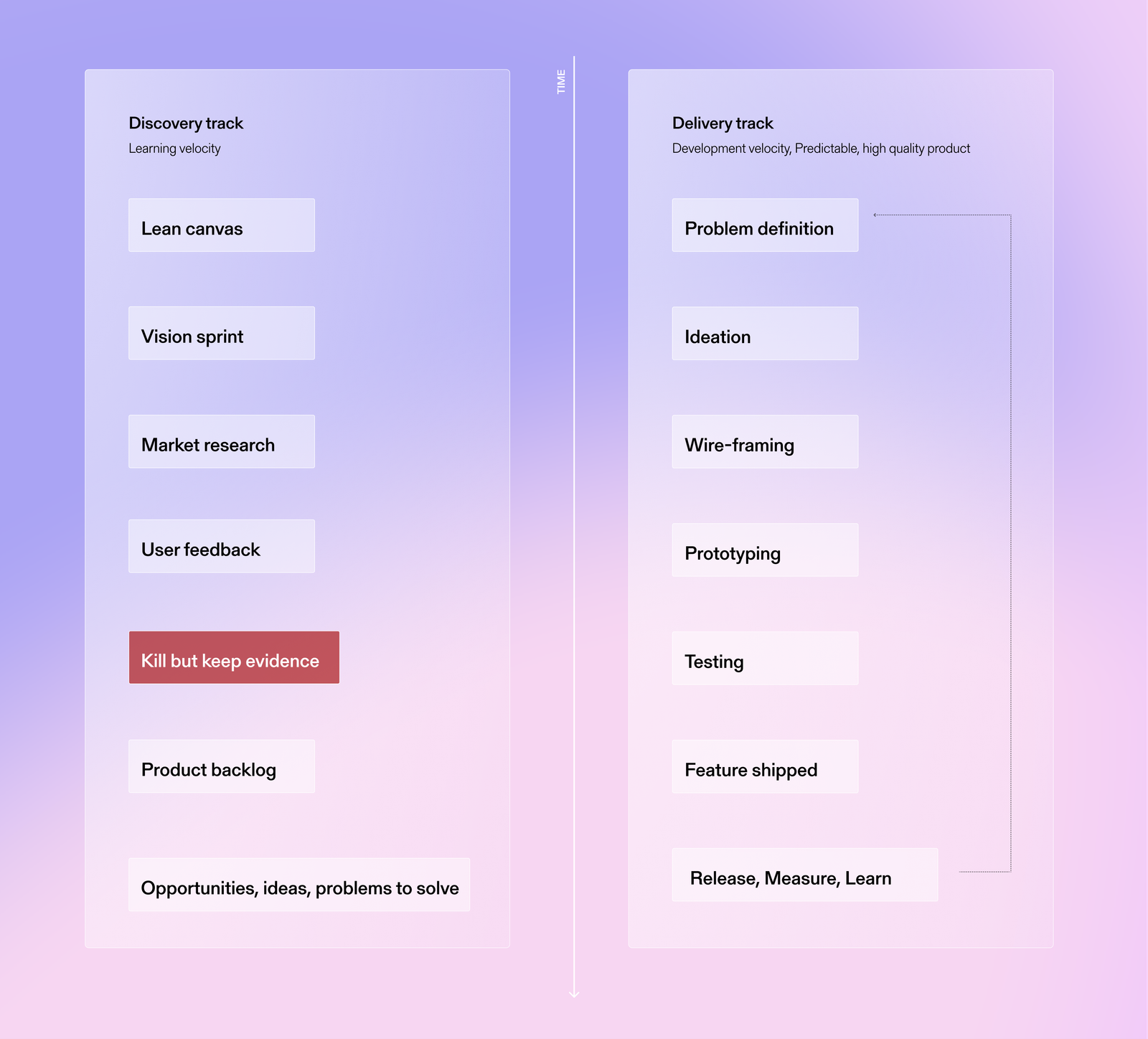
Weekly design sprint structure
Stakeholders: Product, Operations, Sales, Marketing, Engineering.
Monday – Problem definition
What: Weekly Design Kick Off
Scope: Decide on Feature vs Optimization sprint. Review the Design Brief
Wednesday – Ideate & discuss
What: Design Touch Point
Scope: Review design direction/options (if many). Decide which one(s) to explore further
Thursday – Critique
What: Feedback session
Scope: Detailed feedback session on selected option from Wednesday.
Friday – Final review
What: Review solution
Scope: Present final solution to team, discuss if we need more time to iterate based on feedback.
An example of a Design Sprint - Capacity
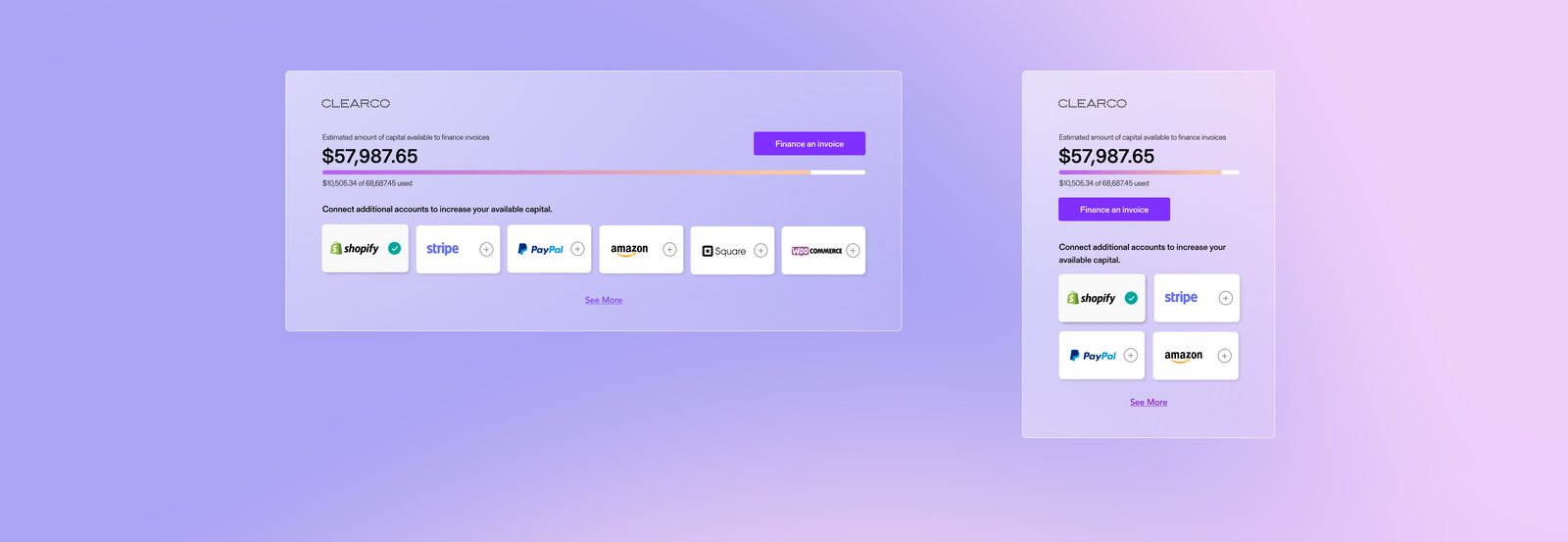
Problem statement
With the start of the original Clearpay experiment, we saw customers uploading invoices above their capacity and returning customers not uploading invoices when there was capacity available. When Clearco couldn’t pay their invoice, some consumers had a poor experience, which affected both the founder and Clearco’s business. Because of this, the product had lower conversion and engagement.
Objective
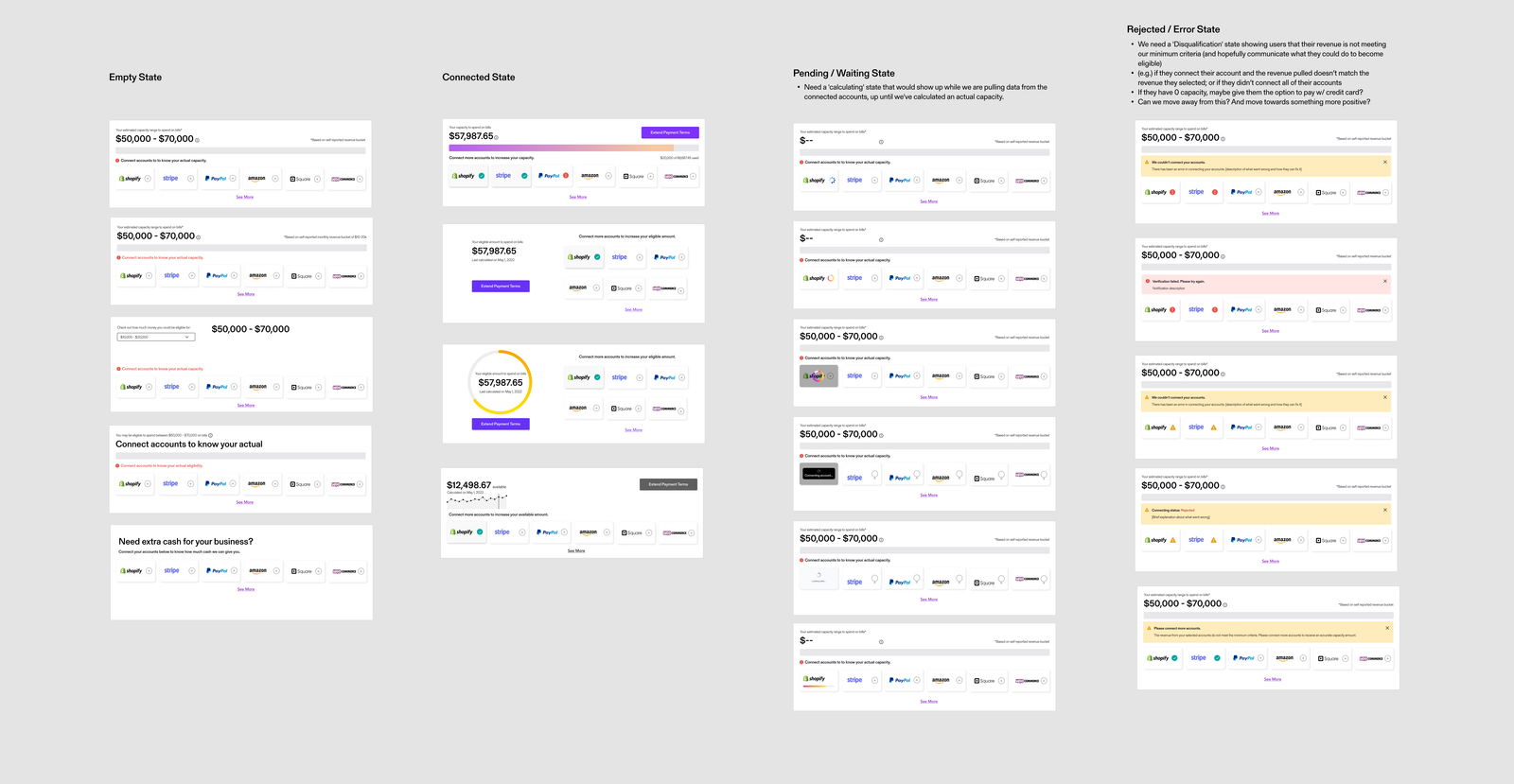
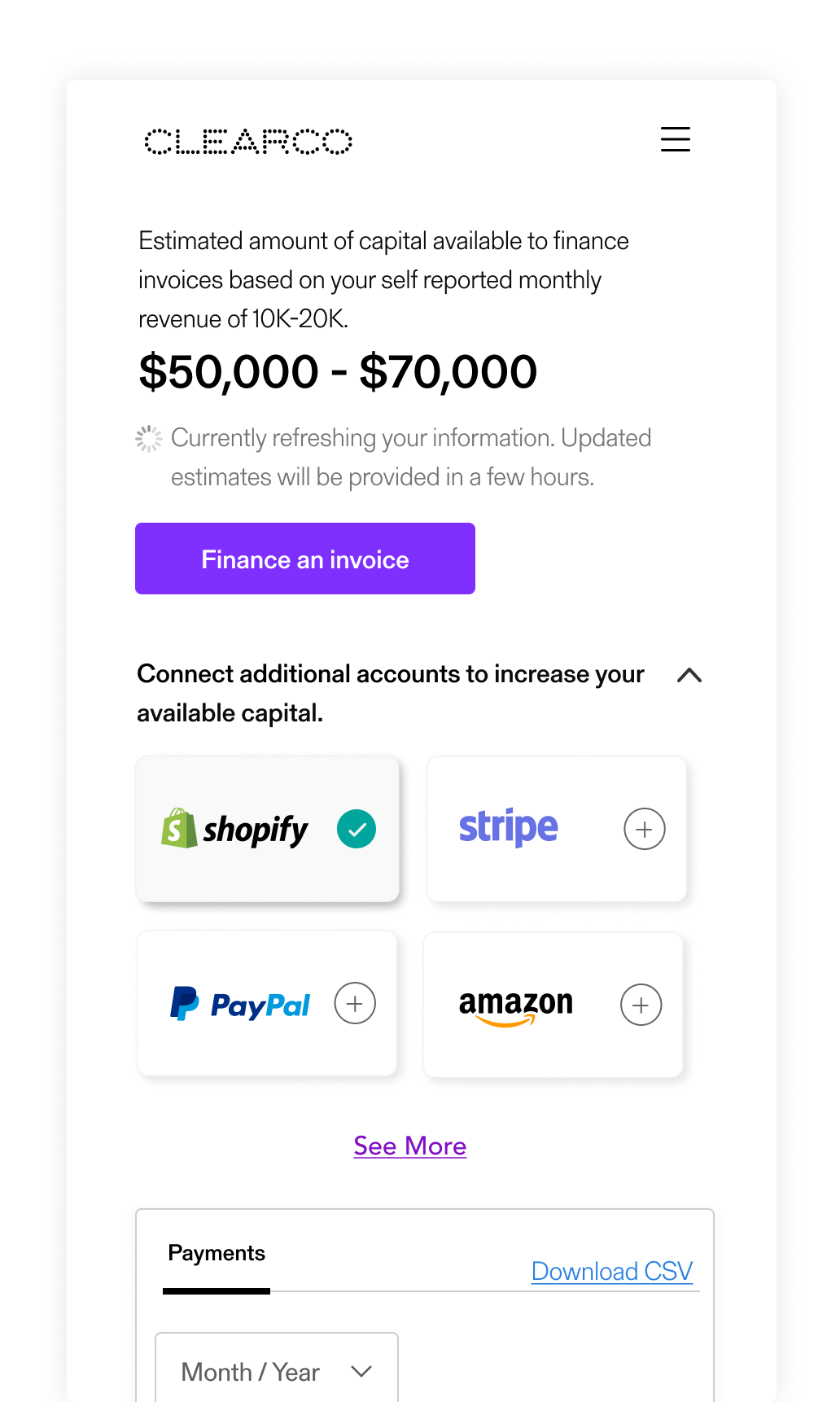
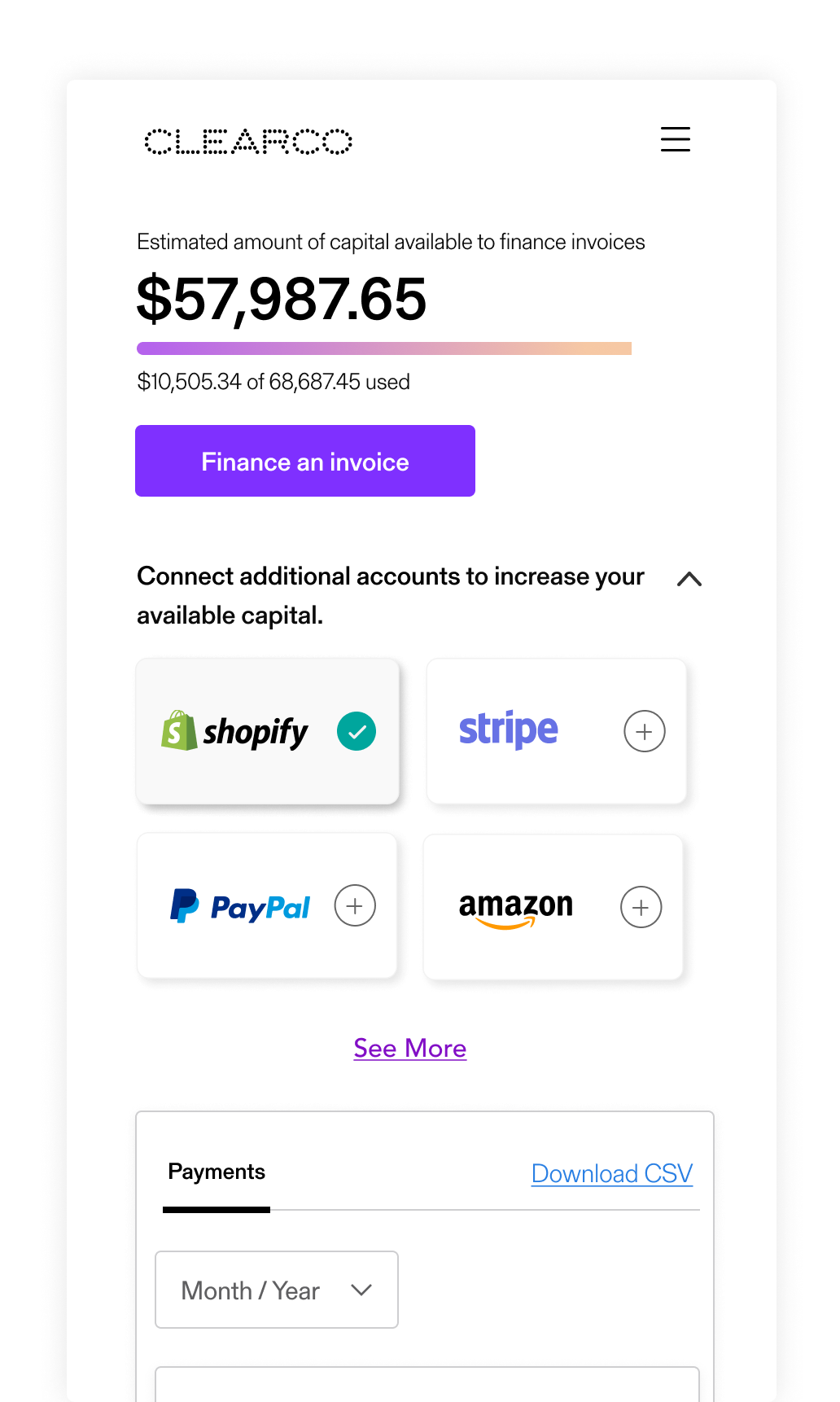
Similar to a “Line of credit”, Clearco wanted to introduce the concept of “capacity” – which is how much capital Clearco can give a customer using the payments platform. “Capacity” is complex because there are so many variables involved in determining how much capital a user is eligible for and communicating this in a succinct yet understandable manner.
Goals
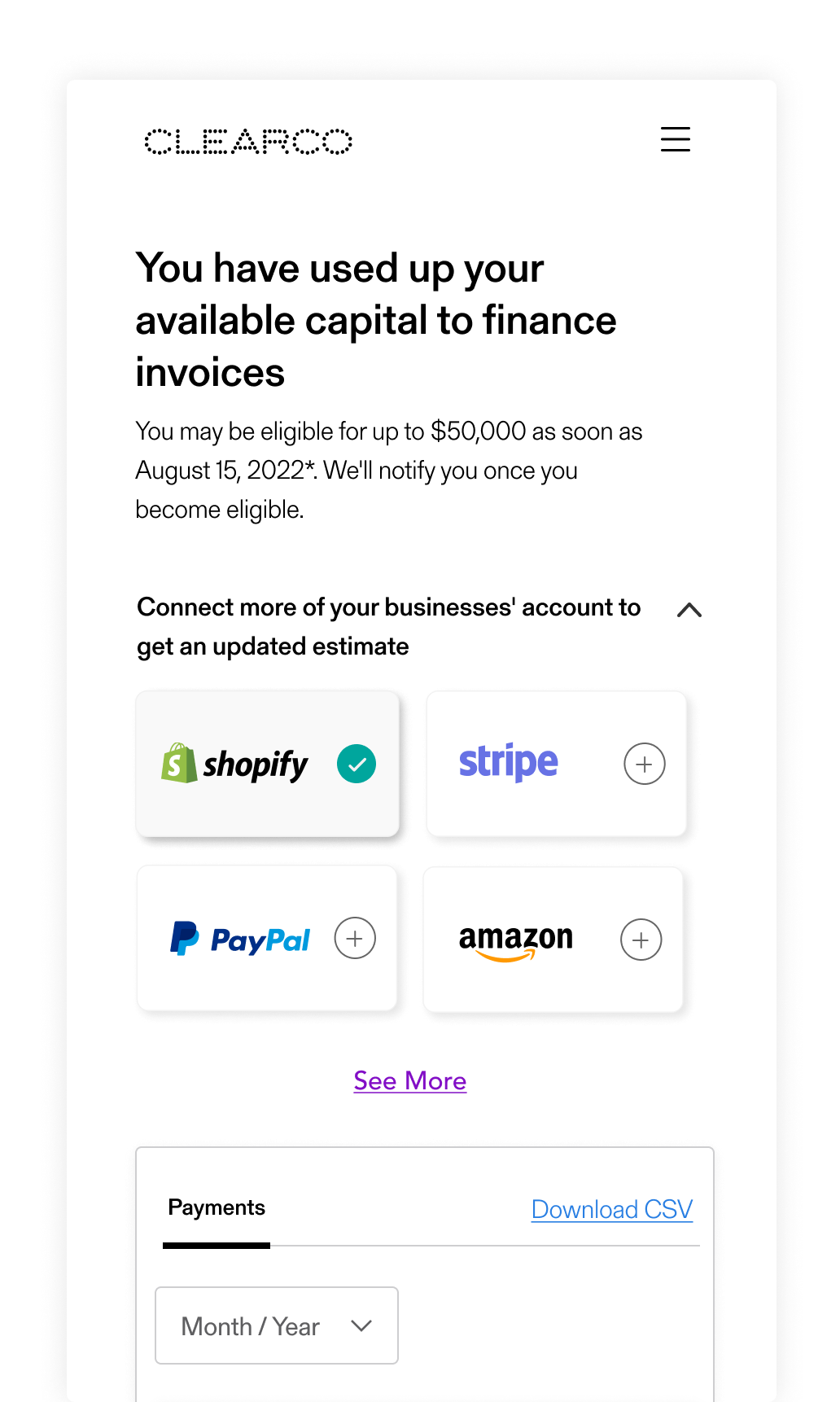
Managing expectations: Founders sitting out of capacity need to easily understand:
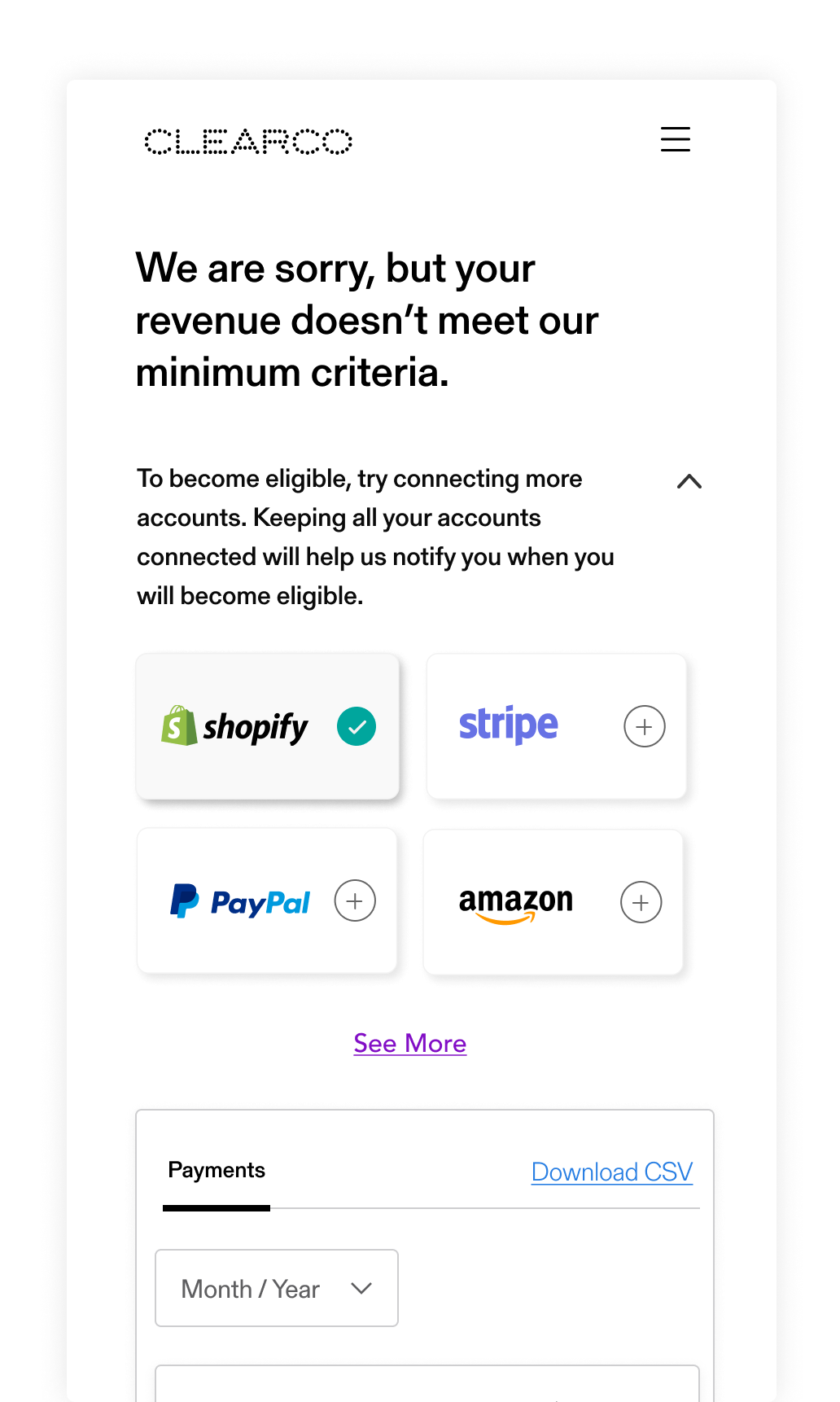
- If there is anything they can do to gain capacity?
- When will capacity be regained?
Be proactive. Notify Founders of freed-up capacity.
Help them understand how Capacity works …. outside the product
- This is not a line of credit. Founders are confused about why capacity is not re-gained as they are repaying Clearco.
Hypothesis
We believe the Capacity module should help drive higher conversion on getting the very 1st bill from new users as well as getting subsequent bills since the remaining capacity will be constantly exposed to users. We know we will be right when we see a higher conversion with net new customers and a higher engagement with existing customers.
Success metrics
50% of users submit their first invoice immediately after signing up.
50% of users submit at least two invoices in the first two months after signing up.
Design Principles
Match Between the System and the Real World.
Minimize doubt, fear, confusion, and hassle for the founder.
Affordance: how do I use it?
Research – How have others?
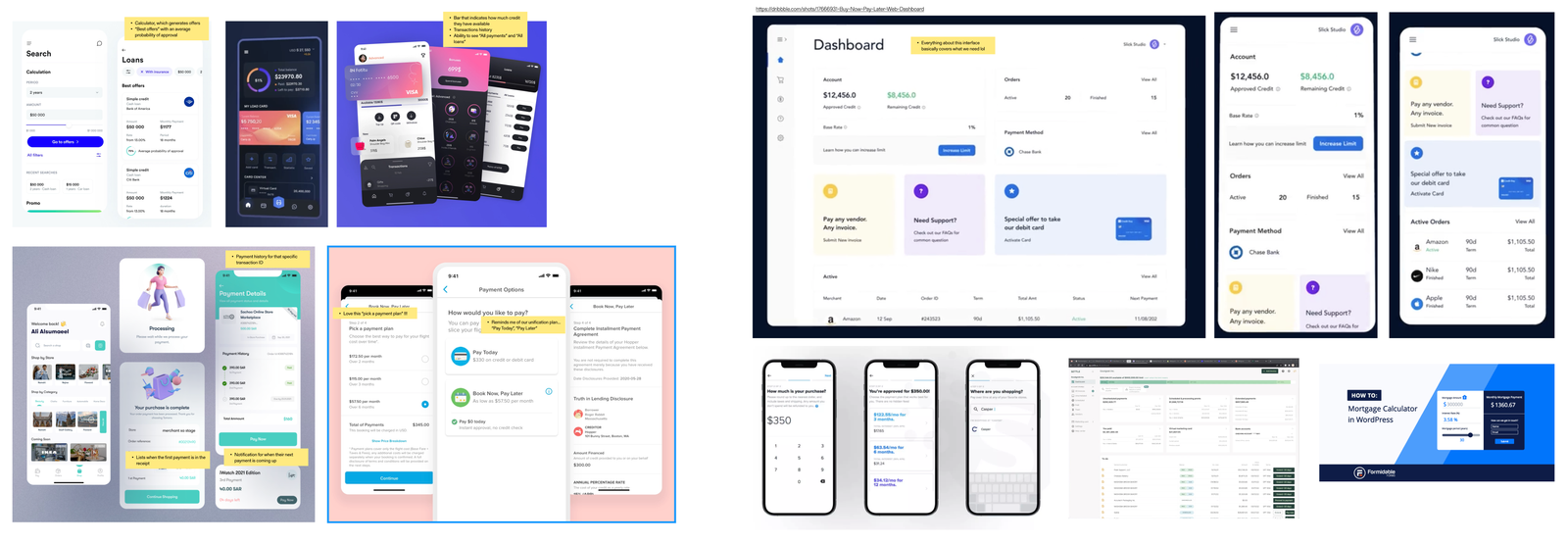
Ideation sketches
User Testing
Background
The purpose of this study is to gather an understanding of how the capacity modal on the main landing dashboard is understood. This includes the potential amount as presented, the steps required to confirm the potential amount, and the word/usage of capacity itself to label the potential amount available to the Founder for BNPL transactions.
Research Objectives
Behavioral
What is the understanding of the capacity as presented when they first land on the screen after completing the onboarding steps including providing their monthly revenues estimate?
What is noticed on the main page at this point? What is not noticed? What is missing that they are looking for?
Is there a frame of reference for participants to compare capacity to? If yes, what is it? If not, is it clear what capacity means to them?
Are the info tooltips engaged with by the participants throughout the flow? If not, do they have questions that could be answered through the information contained in the tooltips? If yes, do they receive the information they were seeking? What information was missing, if any?
Do participants notice that they need to connect their accounts in order to confirm the capacity available?
Do participants connect their accounts, what happens as they move through this flow? What works, doesn’t work, is missing
Do participants understand the revised capacity states; (1) where they are not provided any capacity? (2) where they are provided with a decreased available capacity amount
How is the information the capacity bar is trying to disseminate understood? (ie. amount outstanding, the amount available, total capacity)
Proposal
10 unmoderated sessions; Userzoom panel, 5 moderated sessions;
Participant Criteria:
Current or former business owner (current, former, or never a business funding recipient)
Canada or US resident
30+ years old
Minimum Household Income = $25K
Participants to be compensated through Userzoom
Current Clearco Founders (for moderated)
Participants
Participants to be compensated by Clearco
1 hour moderated session = $100 Amazon GC (currency dependent on geographical location of participant)
Timeline
Discussion Guide + Userzoom plan + Prototype reviewed and finalized
Tuesday June 7: Userzoom Pilot launched; Full Userzoom test launched
Wednesday June 8 + Thursday June 9: Moderated sessions
Monday June 13: Co-analysis session
Tuesday June 14: Design team huddle to review insights
Wednesday Just 15: Final share-out with entire team
Outcome/Insights
When presented with the capacity widget, participants were confused about what action to take from the two available options (“Extend Payment Terms” CTA or connect their sales accounts)
When participants were presented with estimates and calculated amounts, they didn’t understand how we arrived at those amounts
When first landing on the dashboard, the “Extend Payment Terms” CTA caught their attention but they were confused about what it meant and what would happen when they clicked on it
Users liked the “How it works” section and wanted it to be surfaced more. However, they were still confused about how the product worked overall. They didn’t understand…
That they could select different payment terms
How they would repay us back
Whether we would pay their vendors, or if we would give them the money to pay their vendors
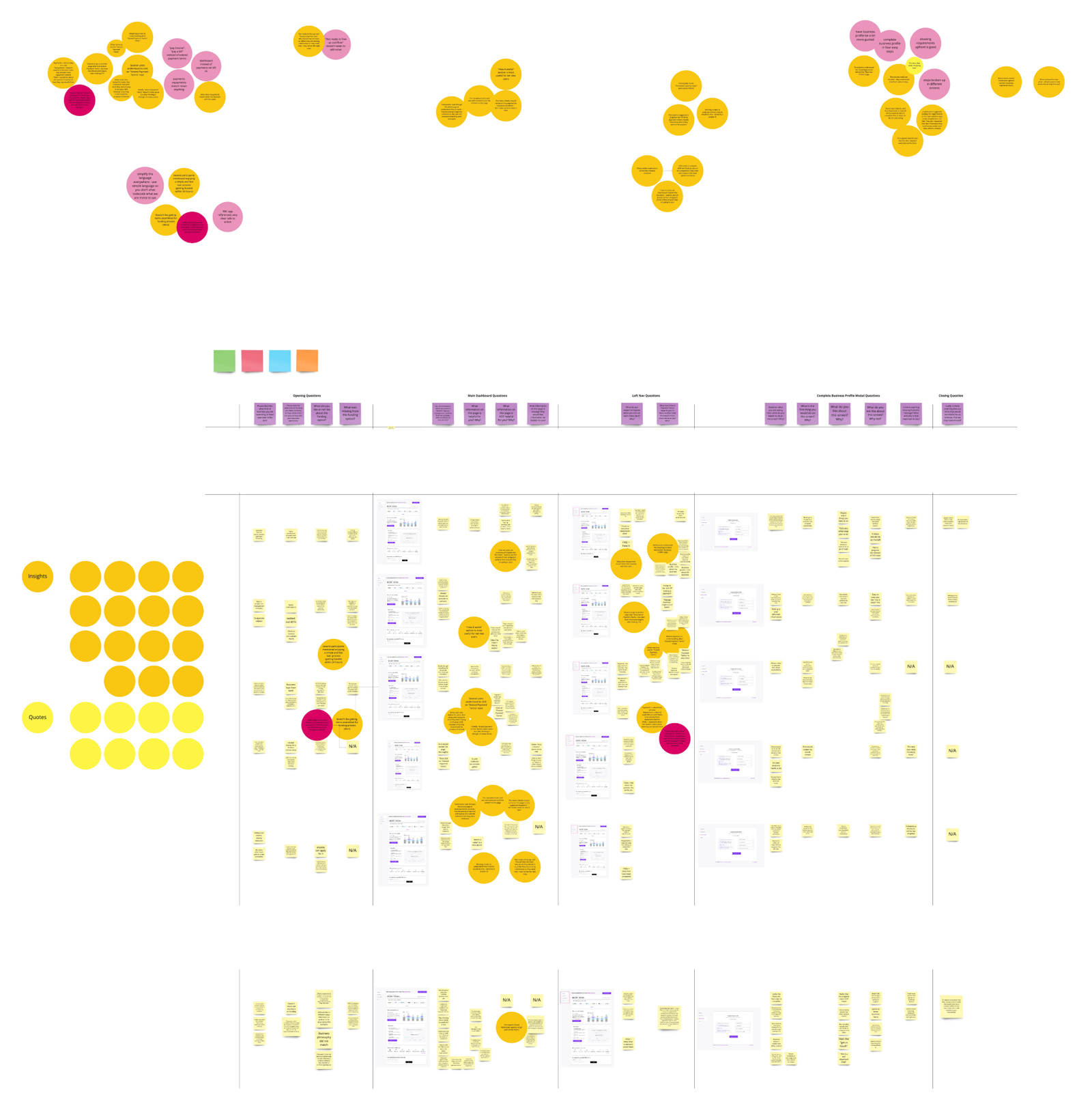
Share-out document
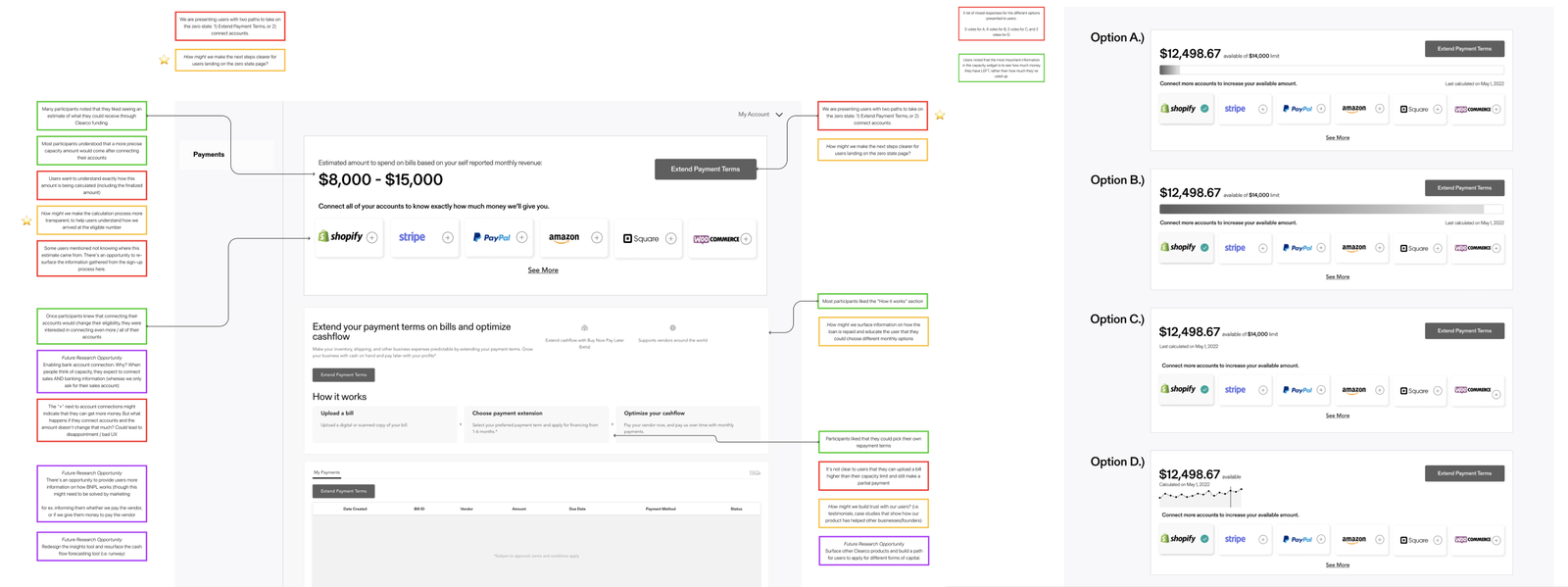
Final screens
Personas

Time Gap Tommy
Tommy does not have the time to apply for a bank loan and get approved before his invoices are due. He also wants to avoid this option because of how time consuming it is and he is confident that he will be good for the money given enough time to sell inventory and receive payment from customers in their upcoming high season. The problem Tommy faces is that his vendor is not being flexible enough with their terms. Tommy wants to maintain a positive relationship with his vendor while also getting a quick solution to extending his invoice payment terms so he is able to manage his cash flow.

Purchase Power Penny
Penny is confident that her product sells and wants to scale up. When negotiating with her vendor, she learns that if she bought in larger bulk, she would be able to get better rates or get ahead of the queue and receive her inventory sooner. The problem Penny faces is that she is not able to leverage MOQ (minimum order quantity) for greater discounts on inventory because she is not able to hold onto enough capital after her immediate bill payments. Penny wants to avoid cash flow constraints and have more purchasing power with her vendors. Extending her payment terms with vendors will allow her to invest in more inventory and grow her business.

Strategic Steve
Steve wants predictability in minimizing his monthly cash outflows. With more cash on hand, Steve feels more confident to make strategic, long term investment decisions. For this founder, it is worth paying a small fee to have the option to always maintain more cash on hand by being able to defer their payments.

Delayed Diana
Diana recently invested in a large marketing campaign to promote her online business. However, with the pandemic creating supply chain issues, her vendors have unexpectedly delayed her delivery date for inventory. Most of her products have been sold out on site for a few weeks now and she is worried site traffic and sales will continue to drop. Diana is on the hook for the costs of her marketing efforts that have unfortunately gone to waste due to these delays. Without being able to turnover inventory as normal, Diana’s business is suffering. She is tight on cash and her regular bills including marketing are piling up. Extending the payment terms of her business/marketing expenses would help keep Diana afloat until her revenue increases.
Customer Journey
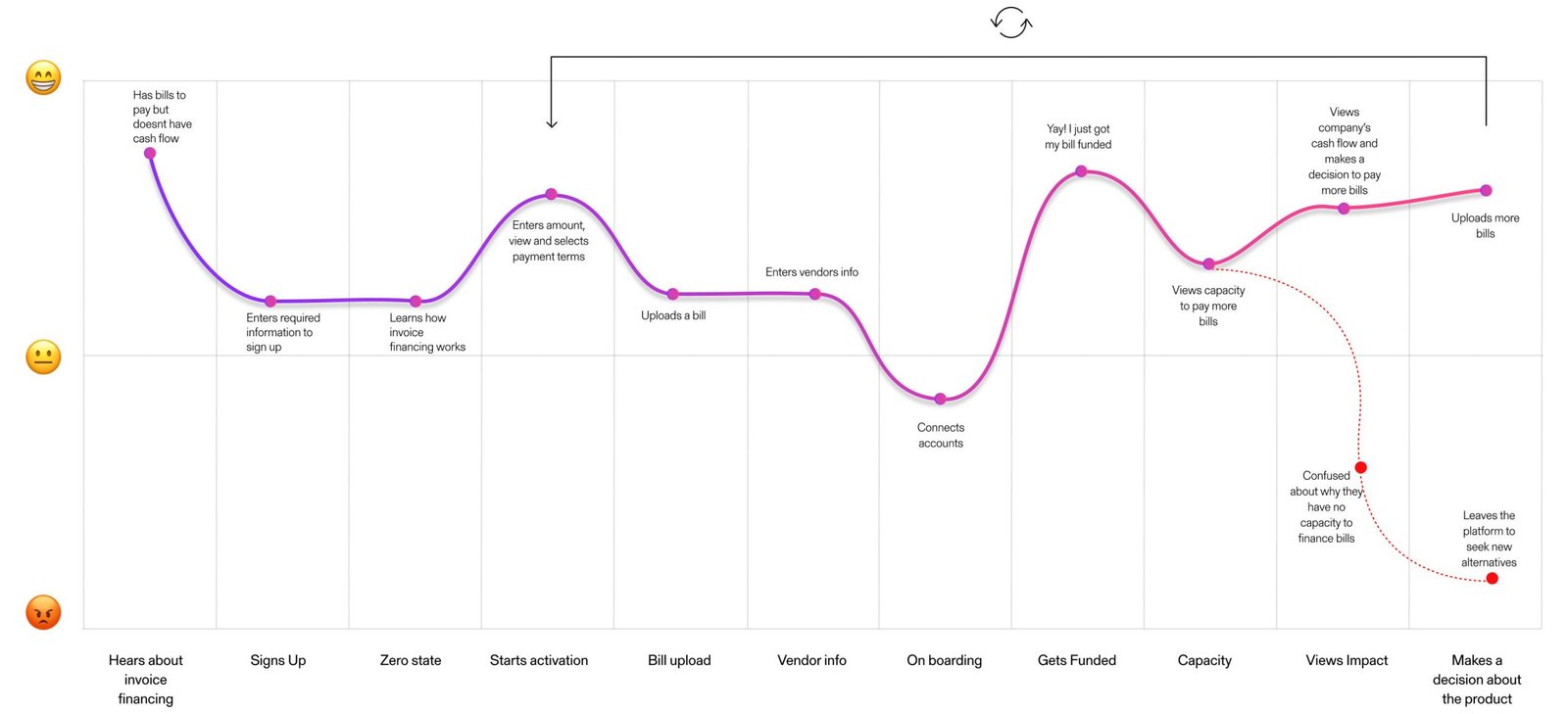
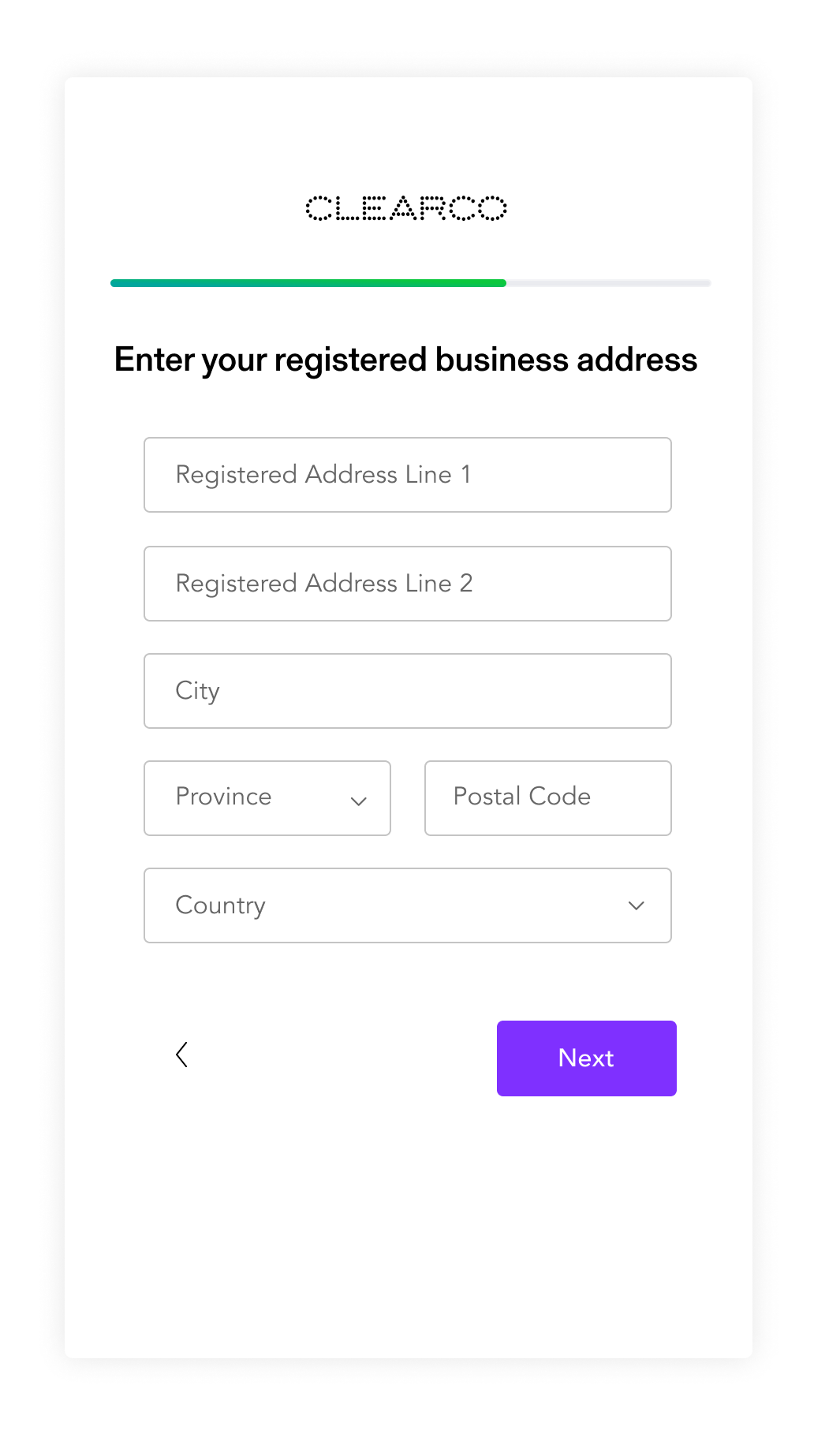
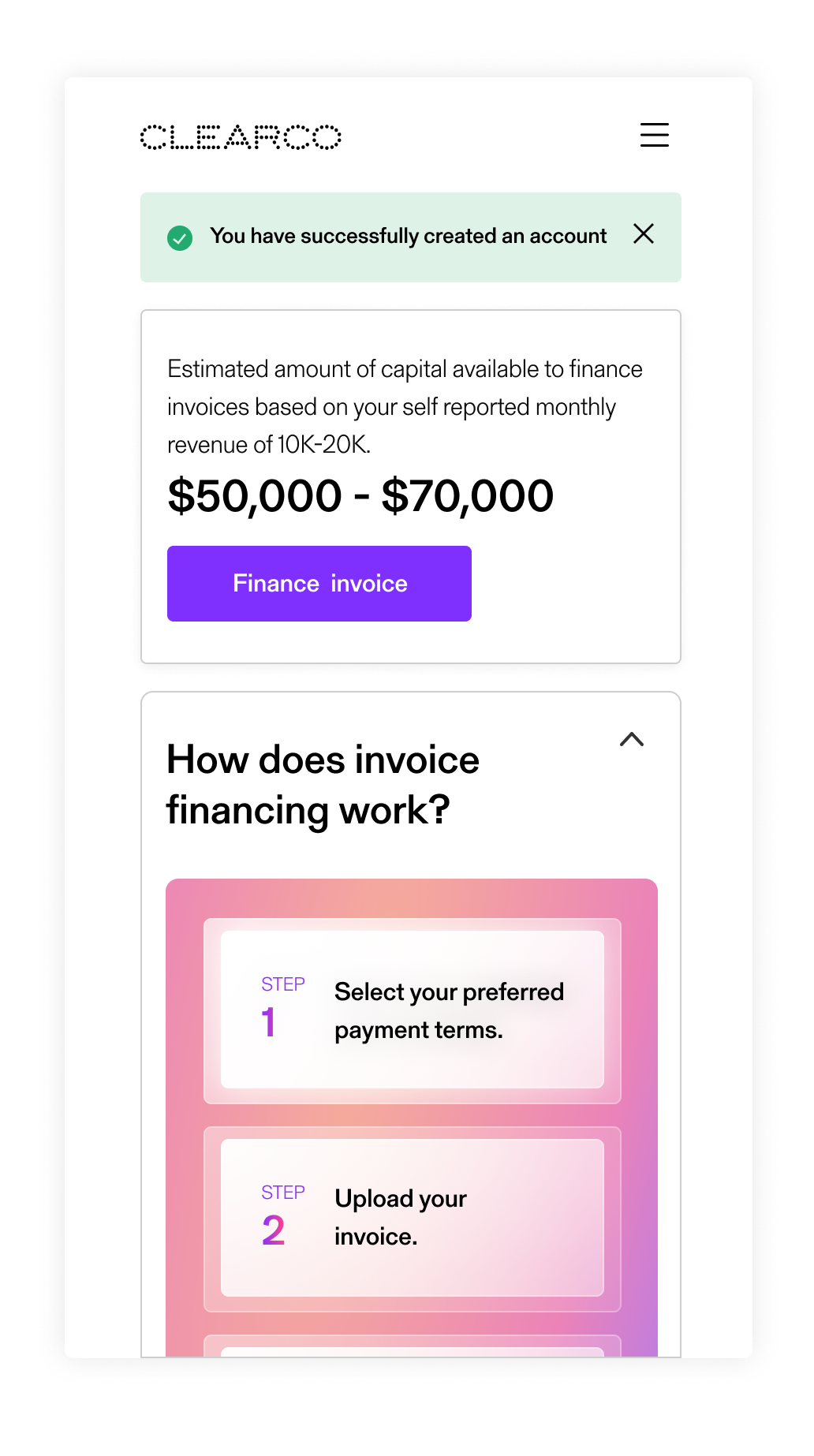
Account Creation
Key Goals & Principles:
- Bring in new customers to the experiment, who do not have a prior history with Clearco.
- Reduce friction by minimizing the amount of data we need, as these customers are coming into just Payments, not capital.
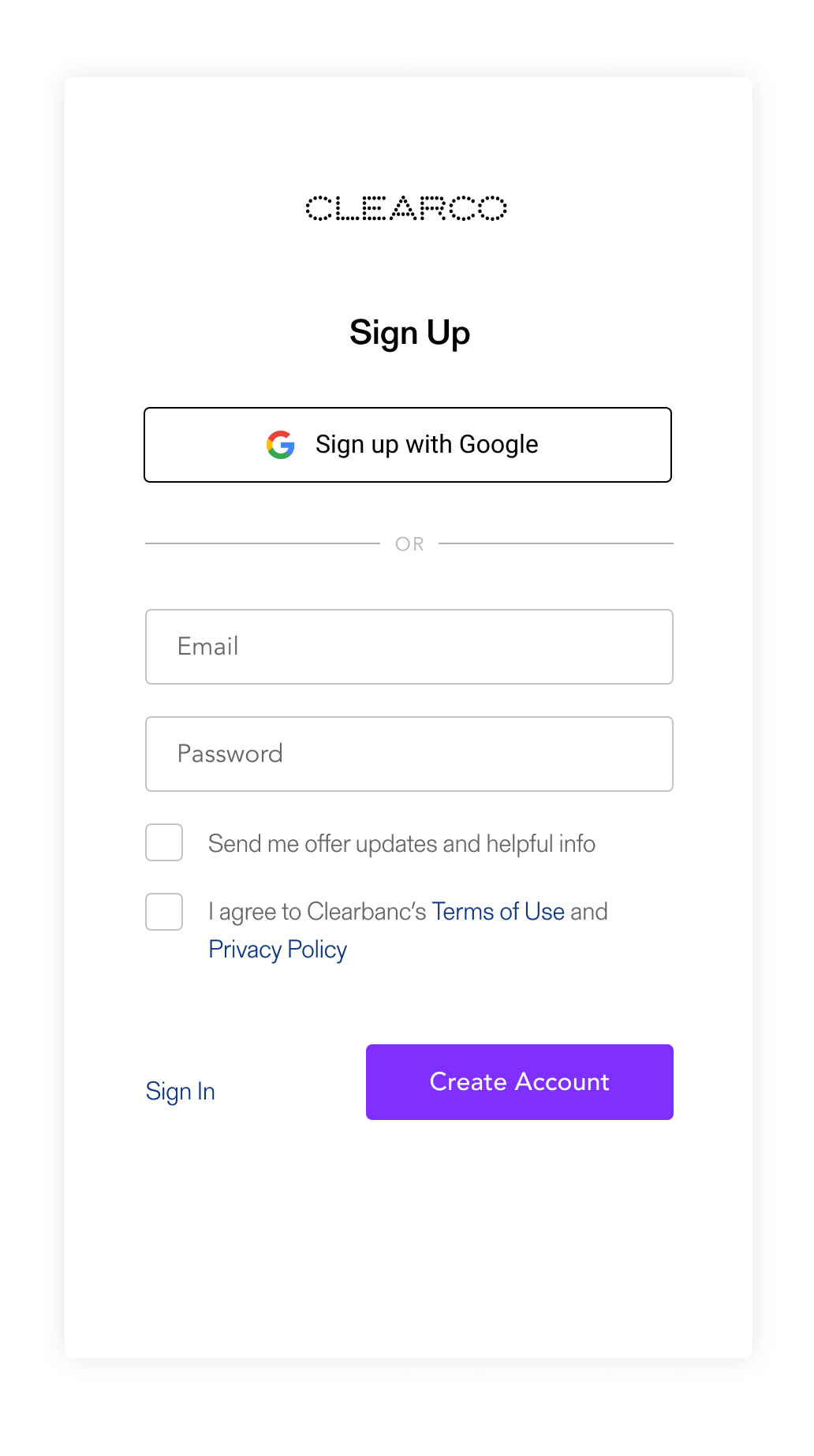
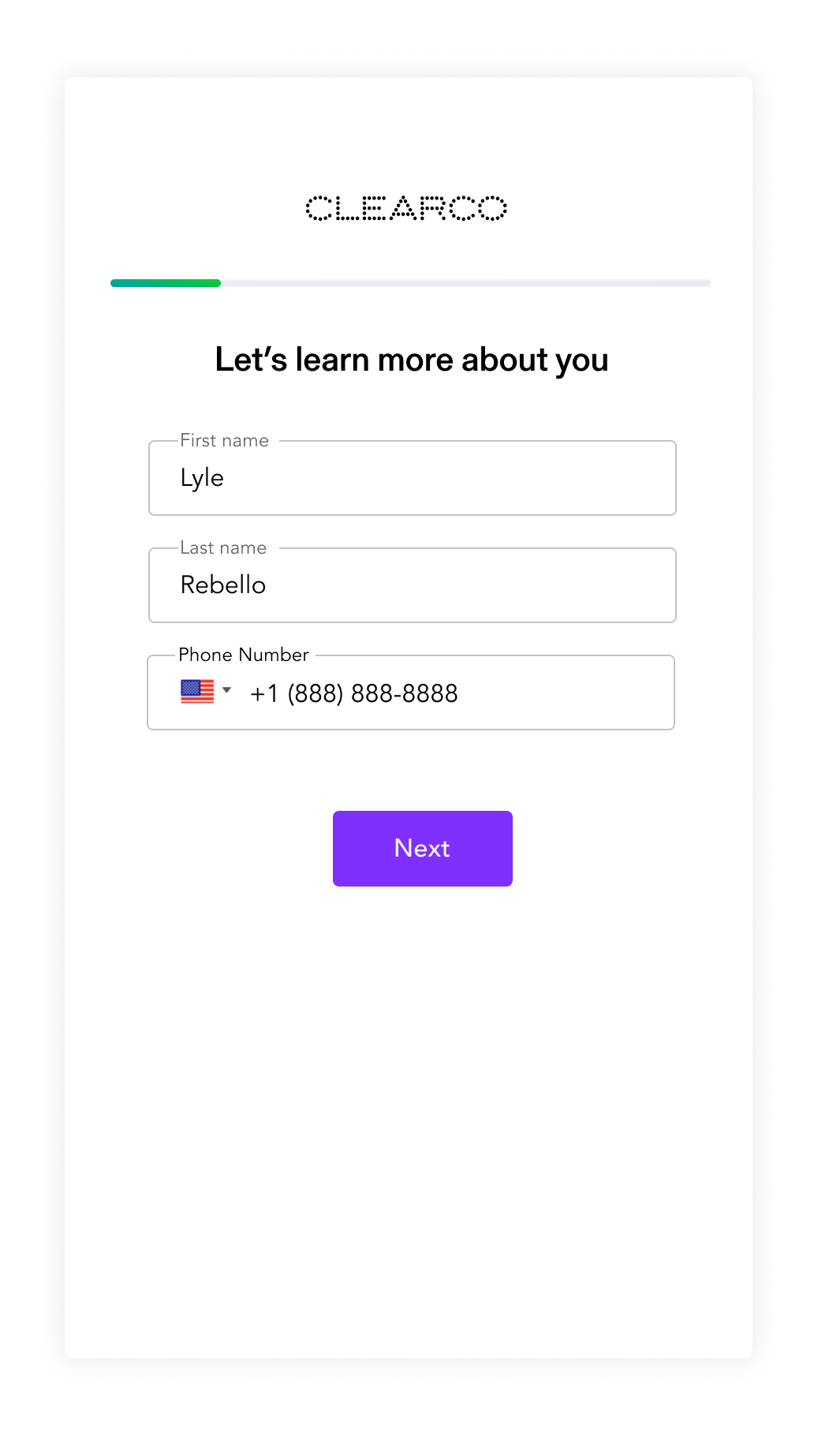
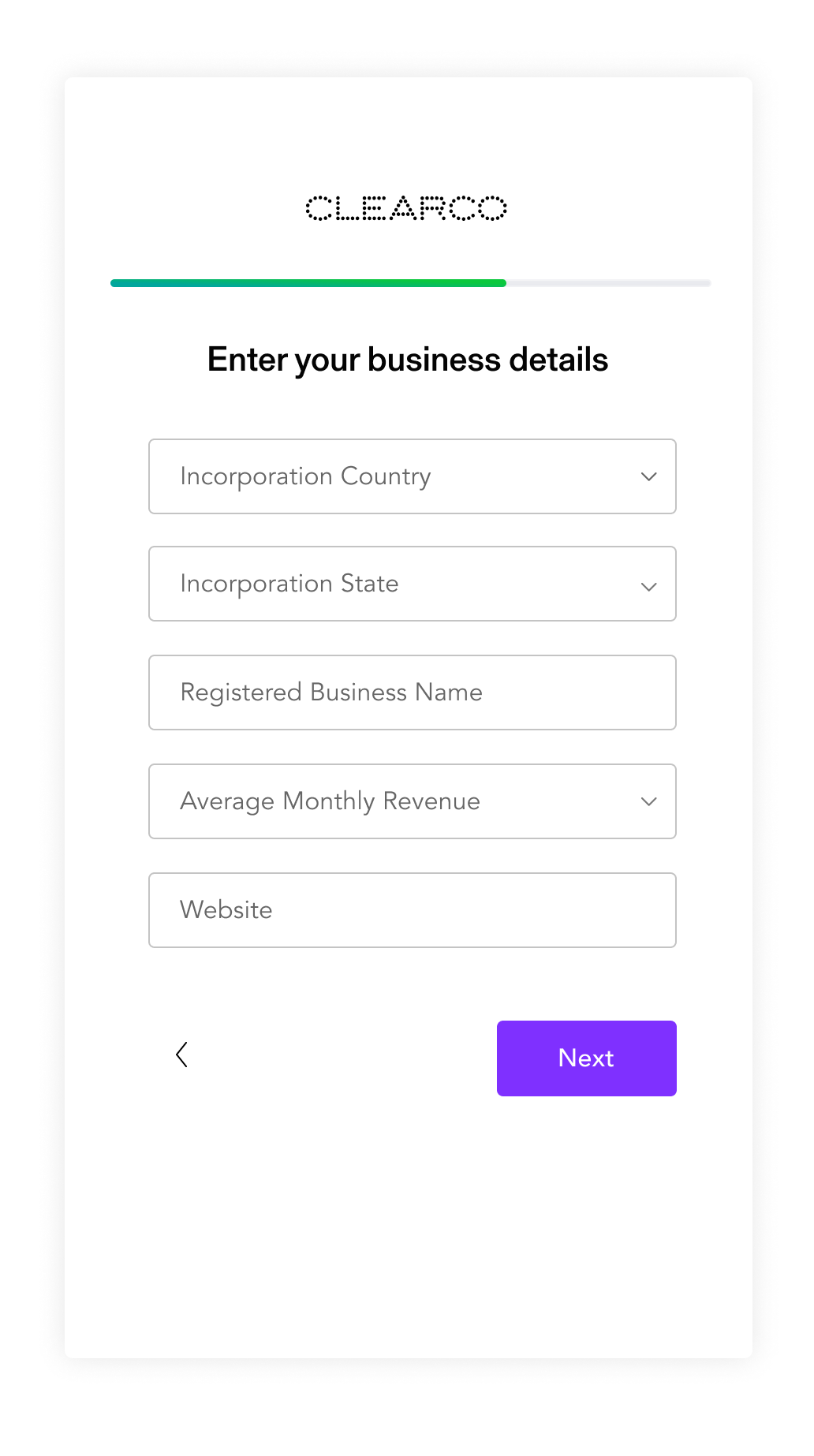
Activation
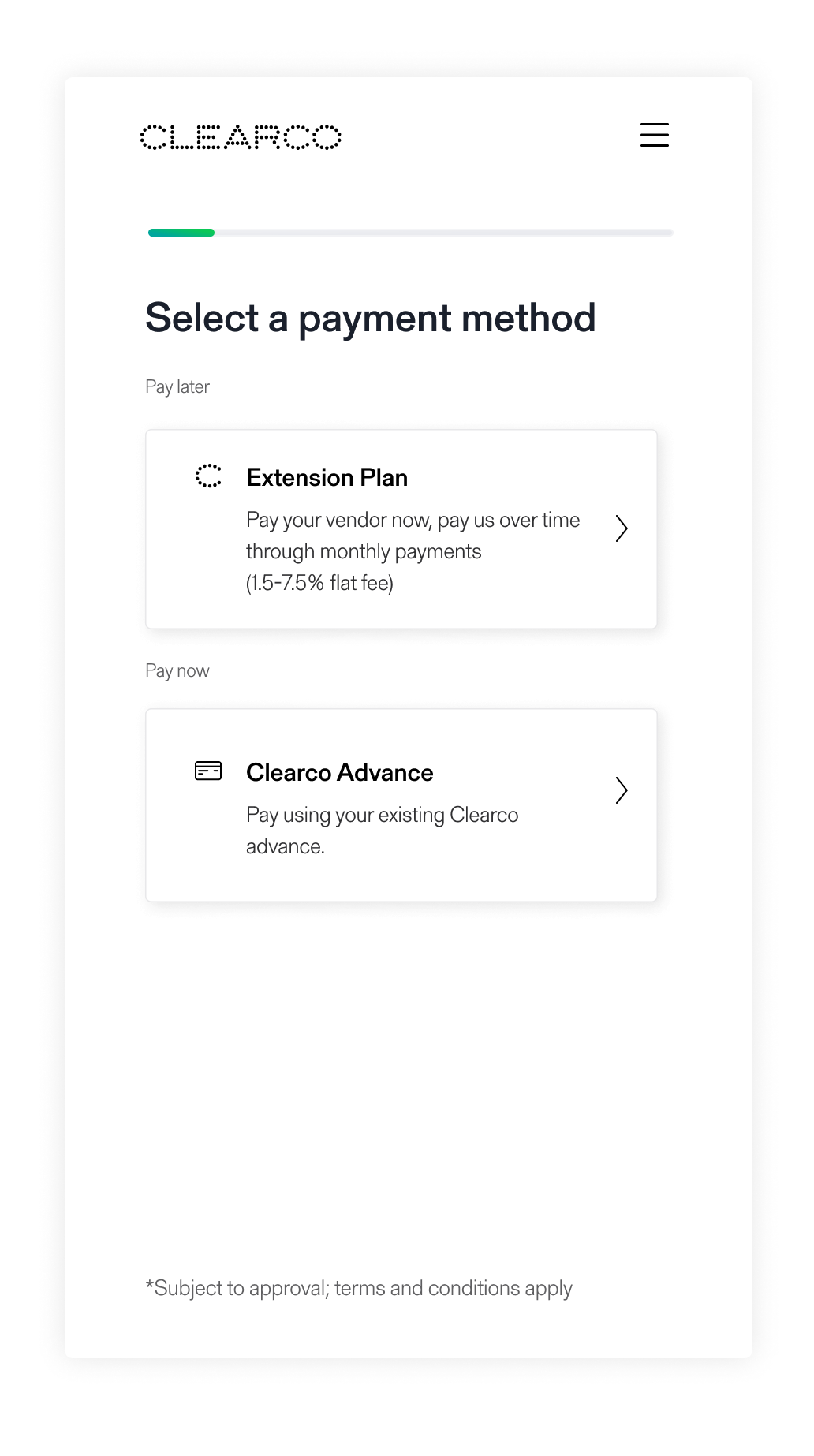
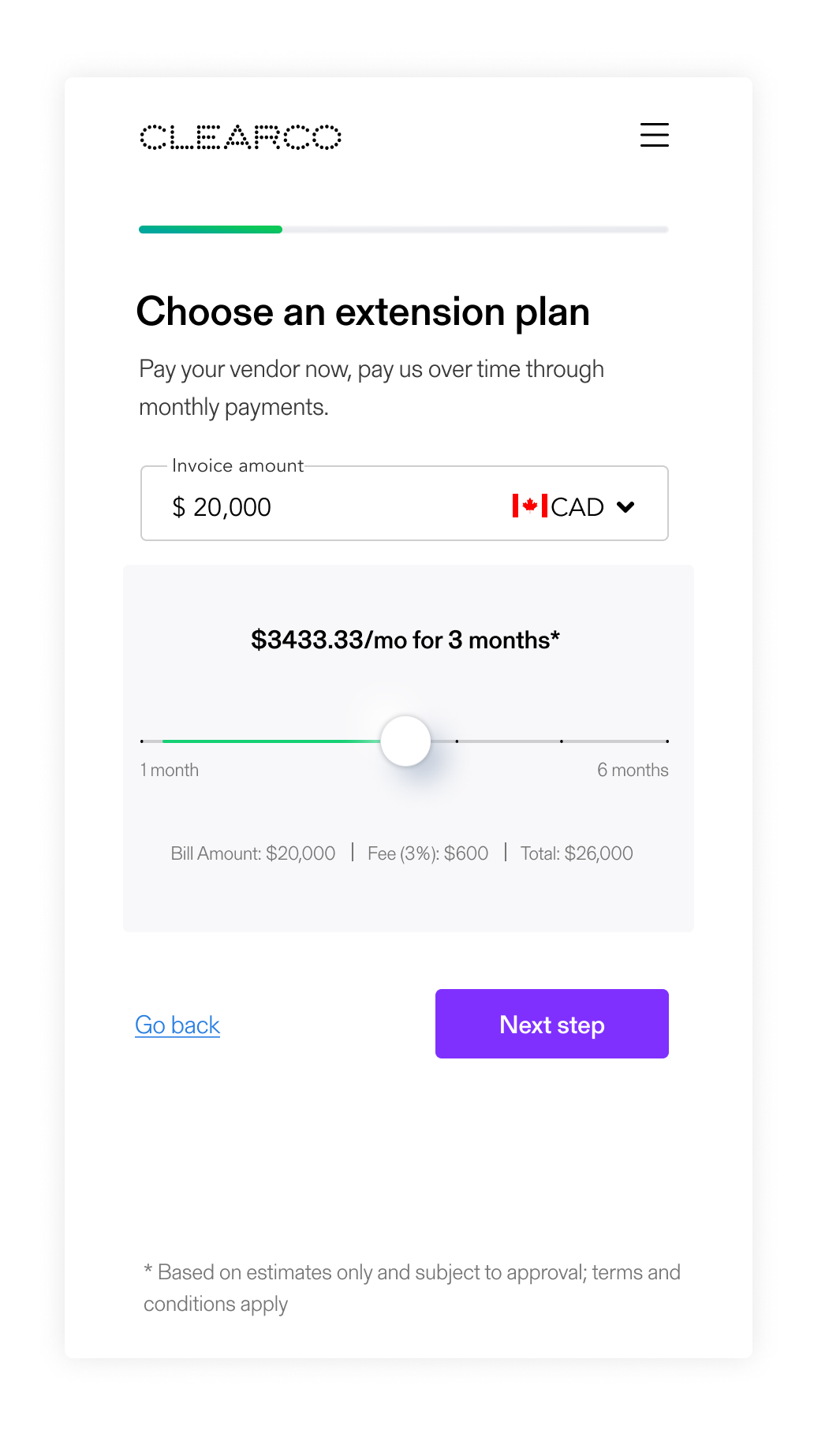
Key Goals & Principles:
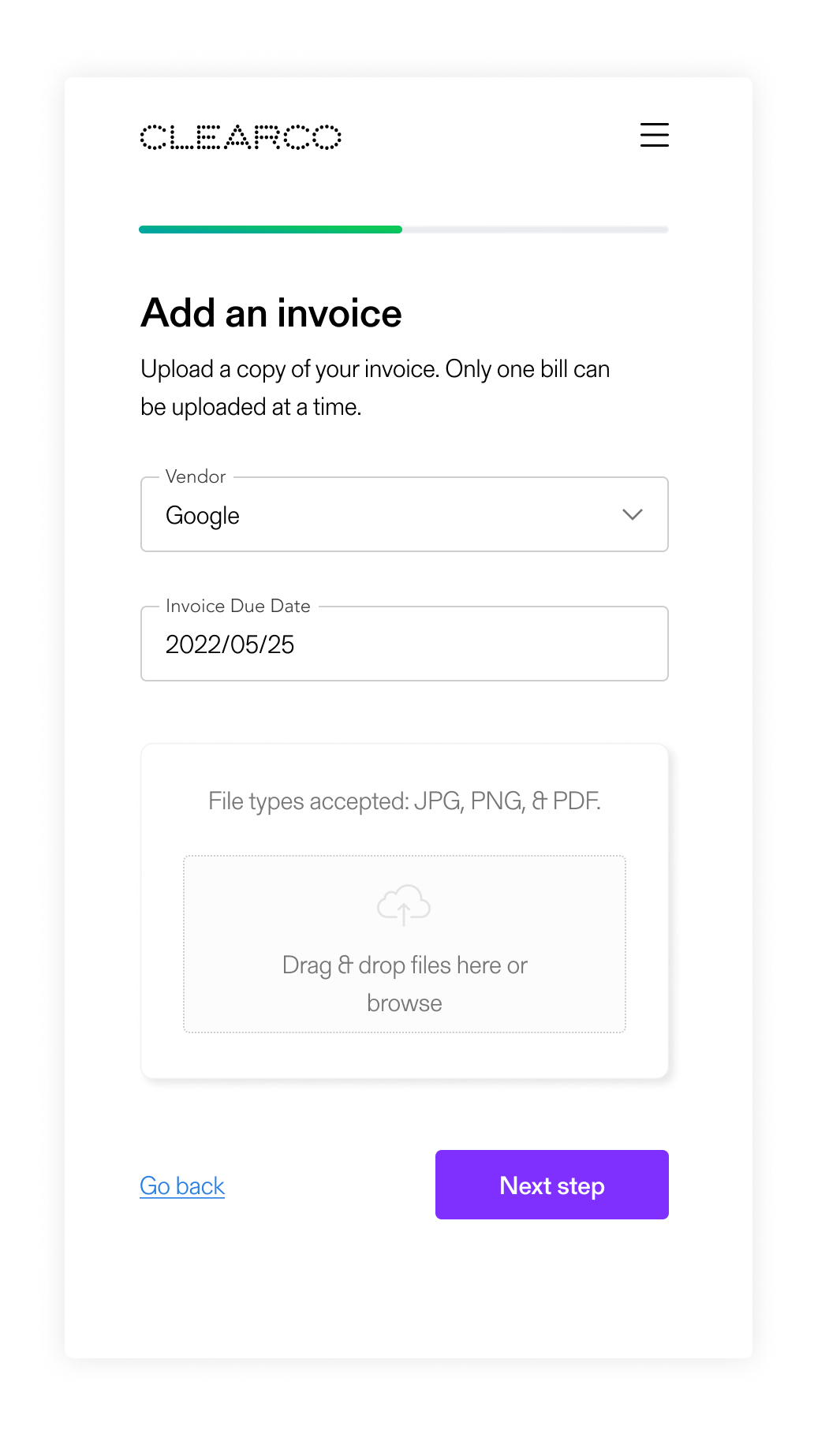
- Create a path for new customers to experience the value of the product ASAP.
- Encourage users to test the product offering by allowing them to upload their first bill.
- Reduce friction by collecting minimum data to process the uploaded bill.
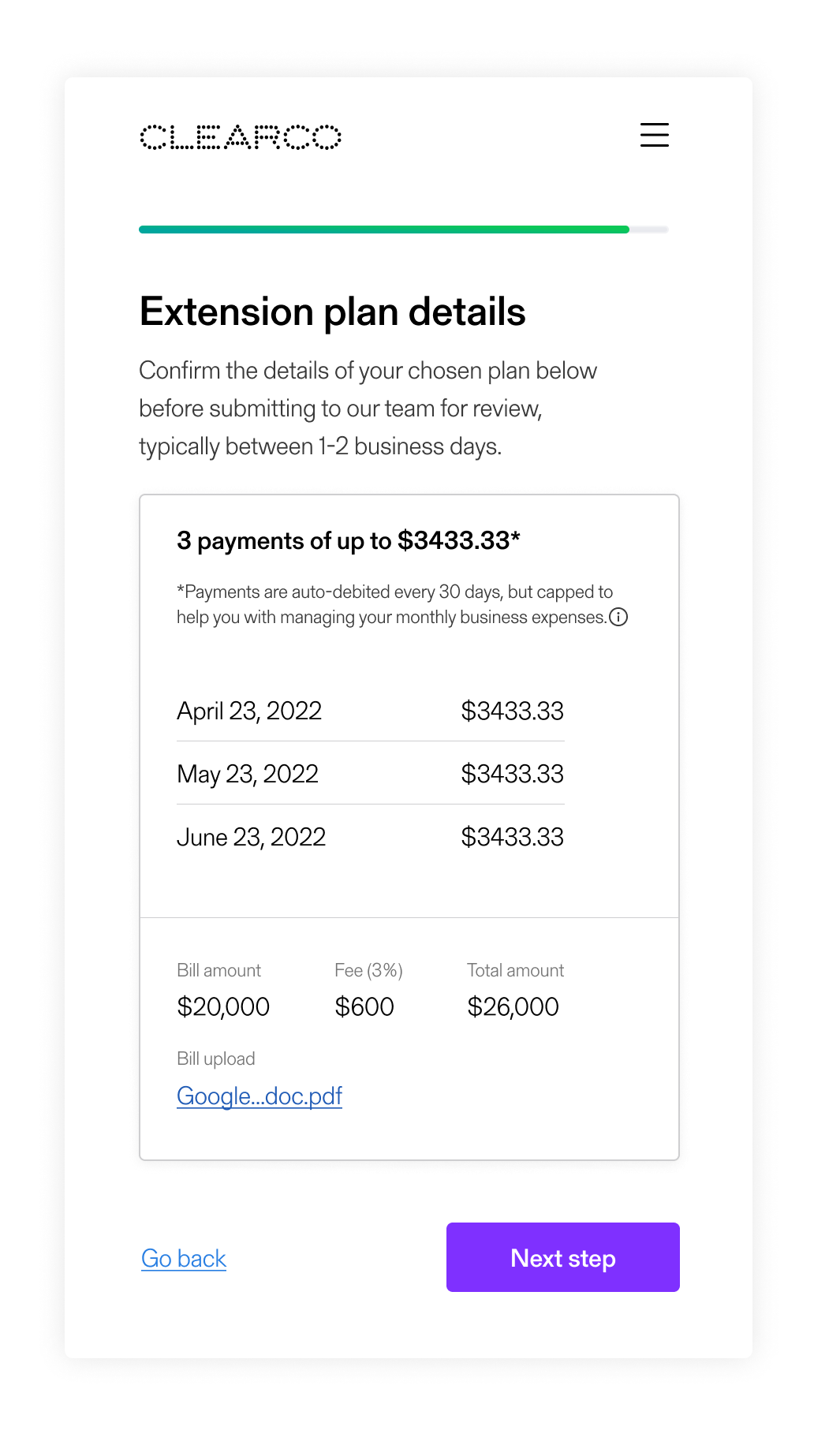
- Introduce education and prompts to reinforce the value proposition, improve (+ establish) trust and highlight convenience.
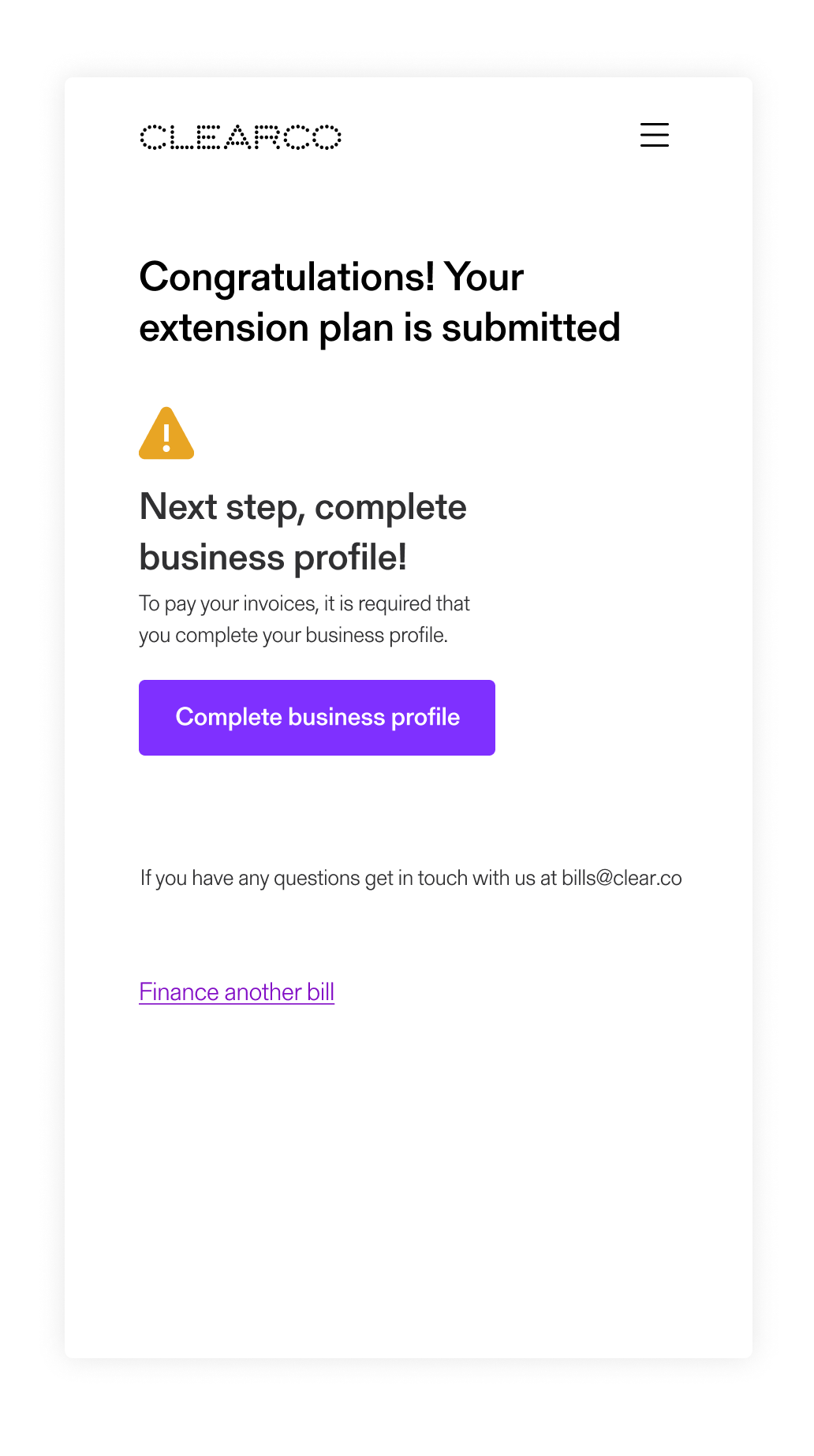
- Build trust with our customers by creating transparency around expectations.
- Highlight the fact that founders can defer payment for their bills.
- Some will come to us well aware of the offering.
- Others will discover it as they use the product.
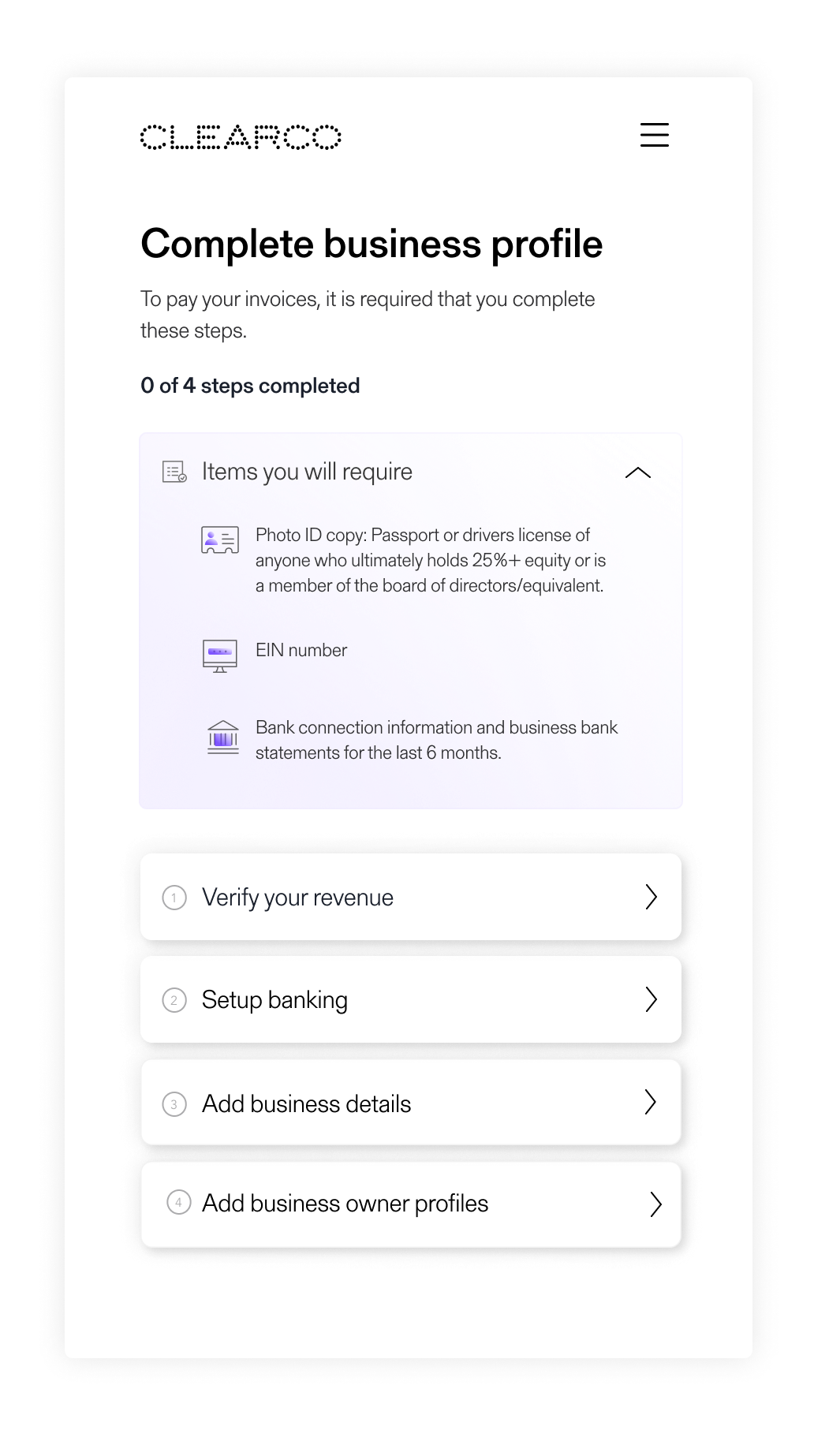
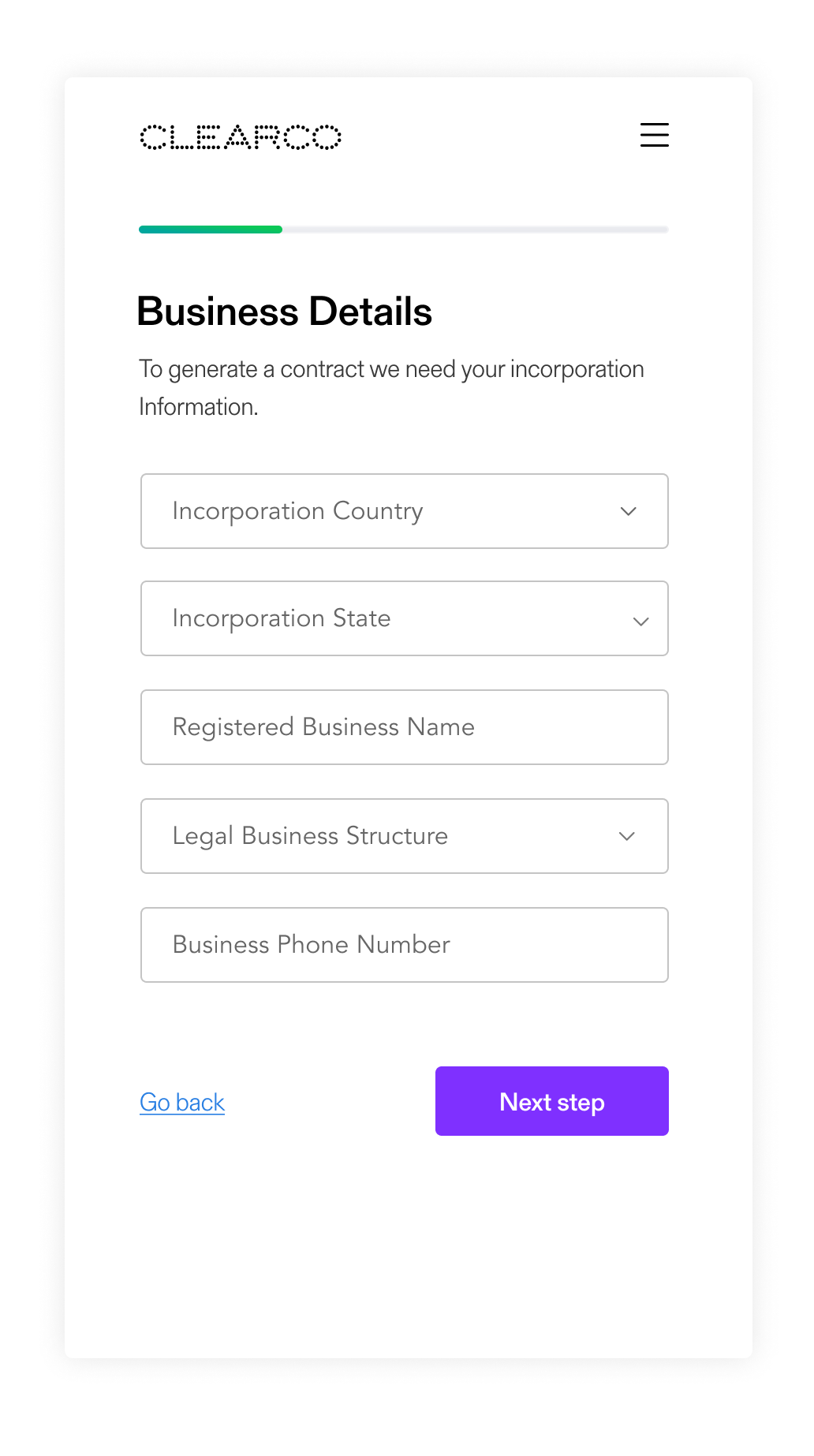
Onboarding
Key Goals & Principles:
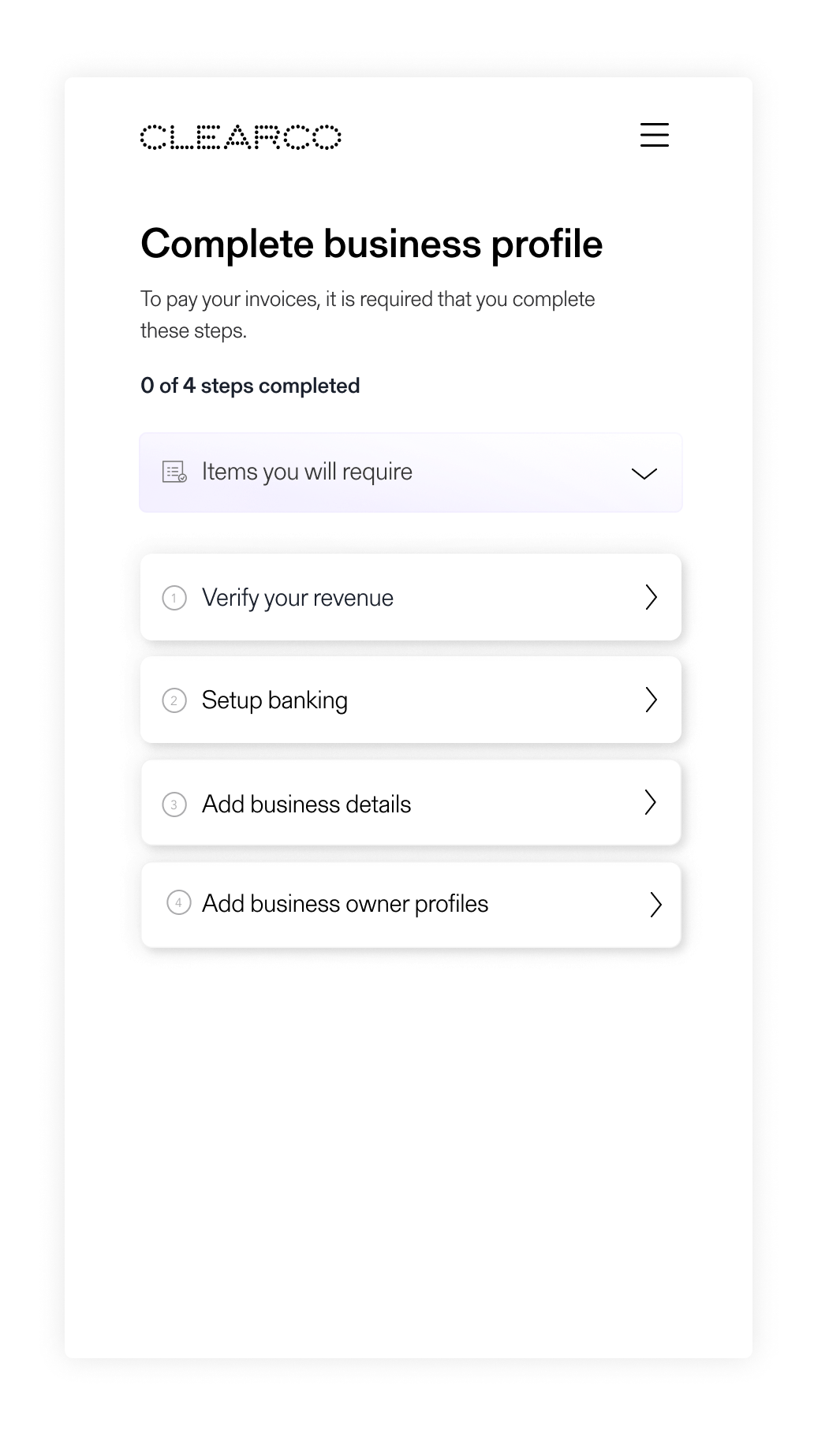
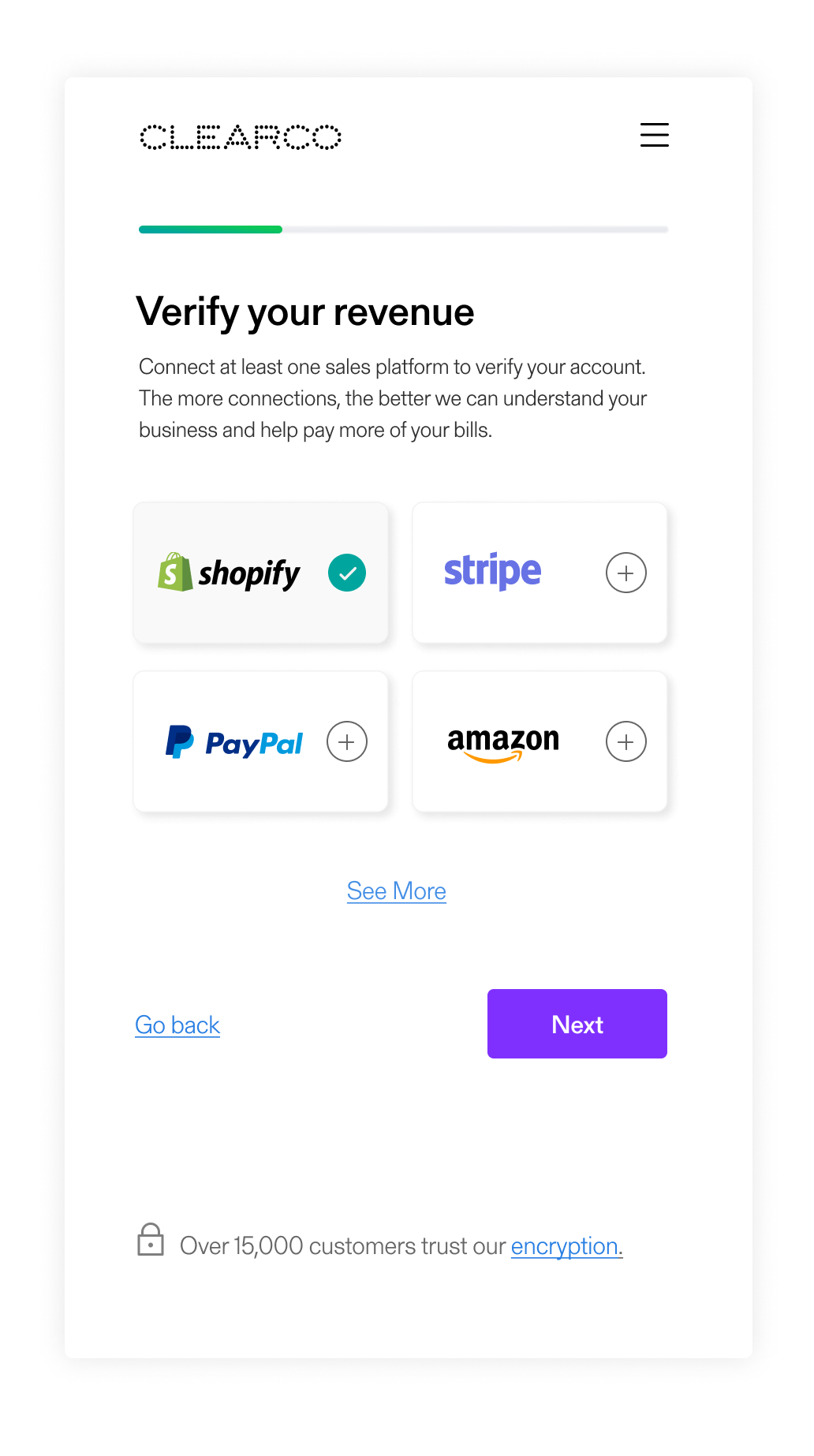
- Compress time-to-capital. Knowing that we can only start underwriting a founder once they’ve connected a revenue account, we need to have them want to connect one asap.
- Remove the operational/human burden. Eliminate the need to reach out to founders after they’ve submitted a BNPL application just to tell them that they have more work to do before we can make a funding decision.
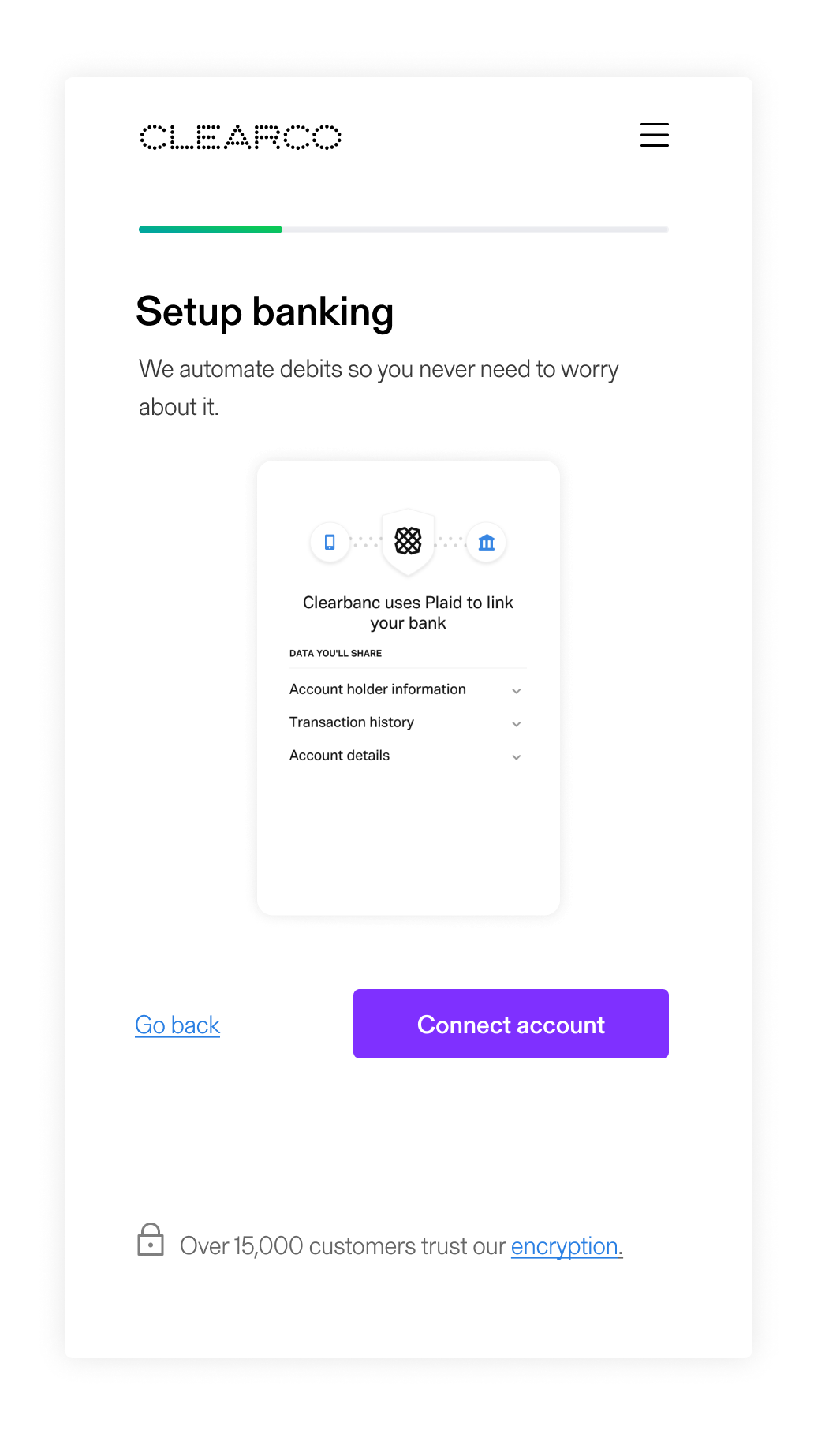
- Leave it optional. As much as we would love it if founders were to give us all we want in a single sitting, there might be reasons why they cannot connect a revenue account or a bank account on the spot. We want to ensure that we still allow them to submit a BNPL application.
- The experience should feel trust and privacy first.
Payment Transactions
Key Goals & Principles:
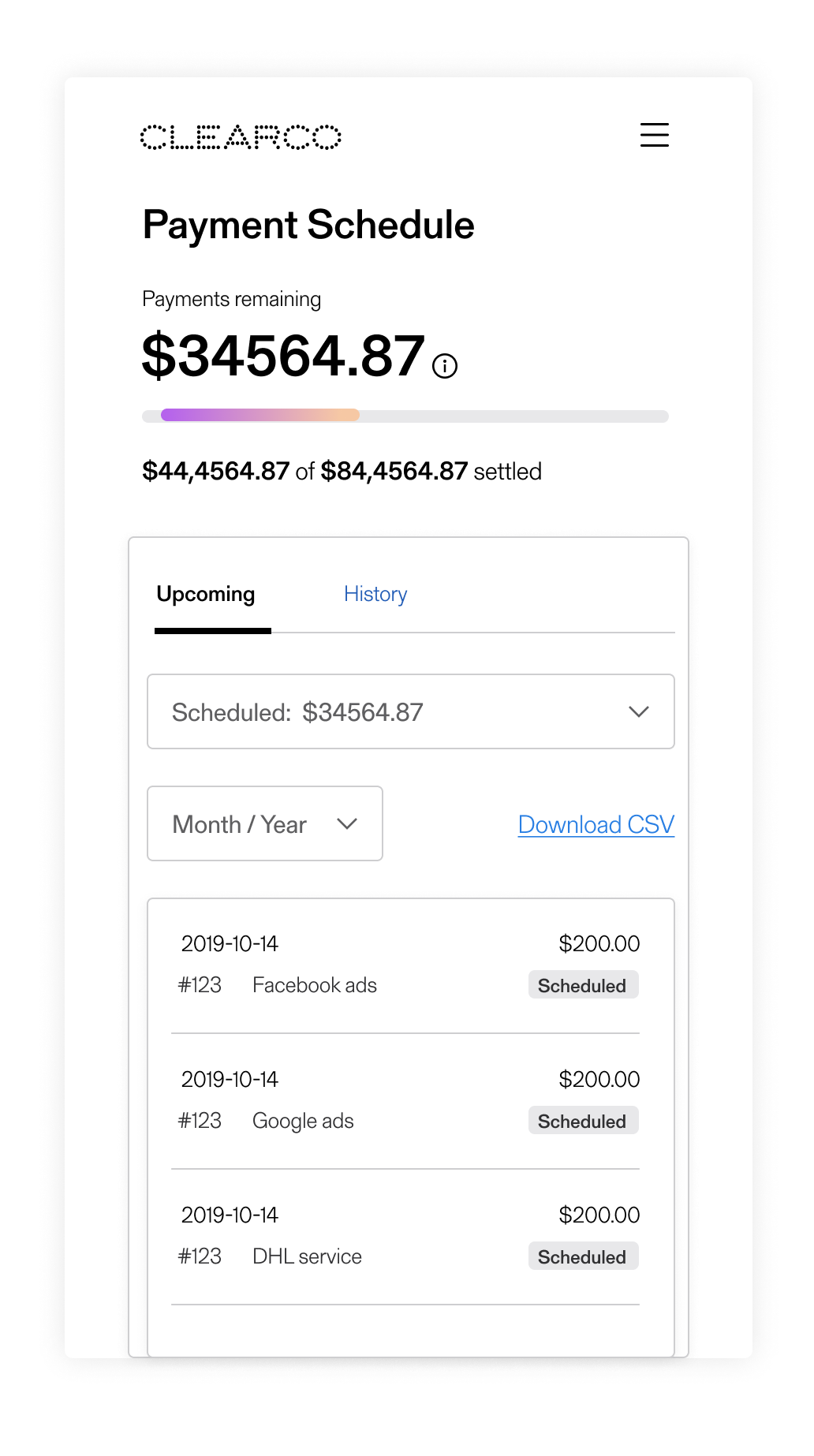
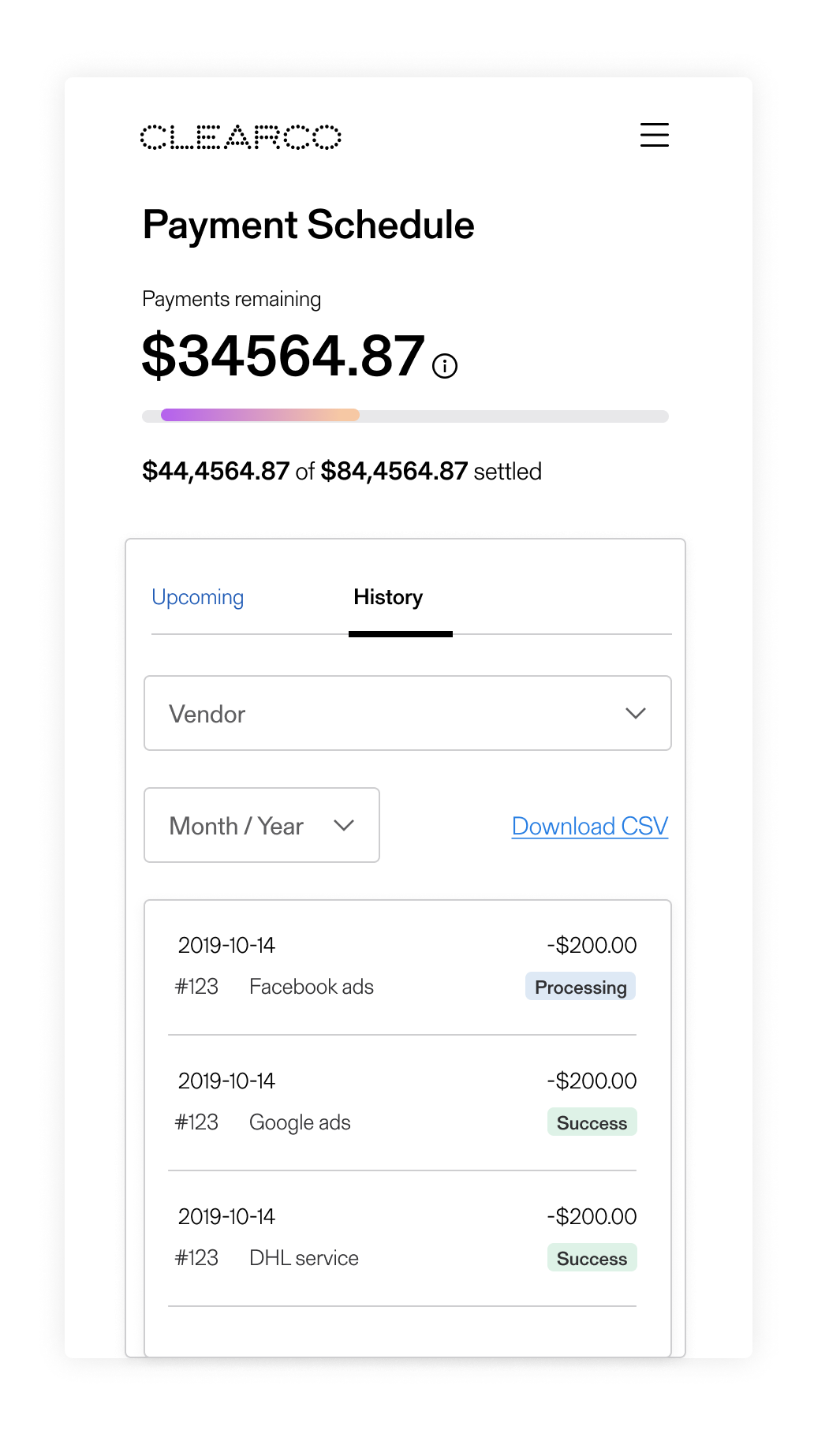
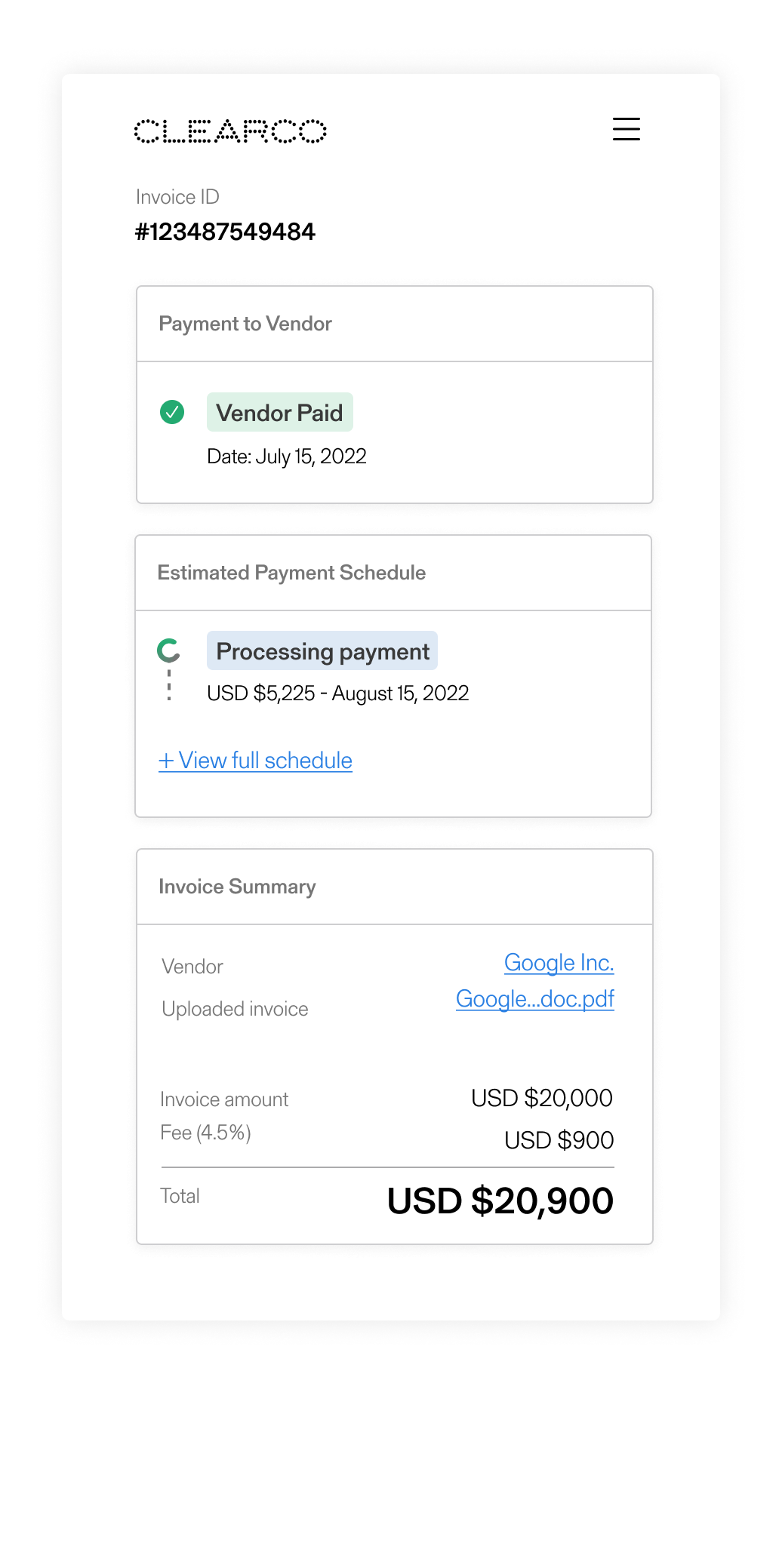
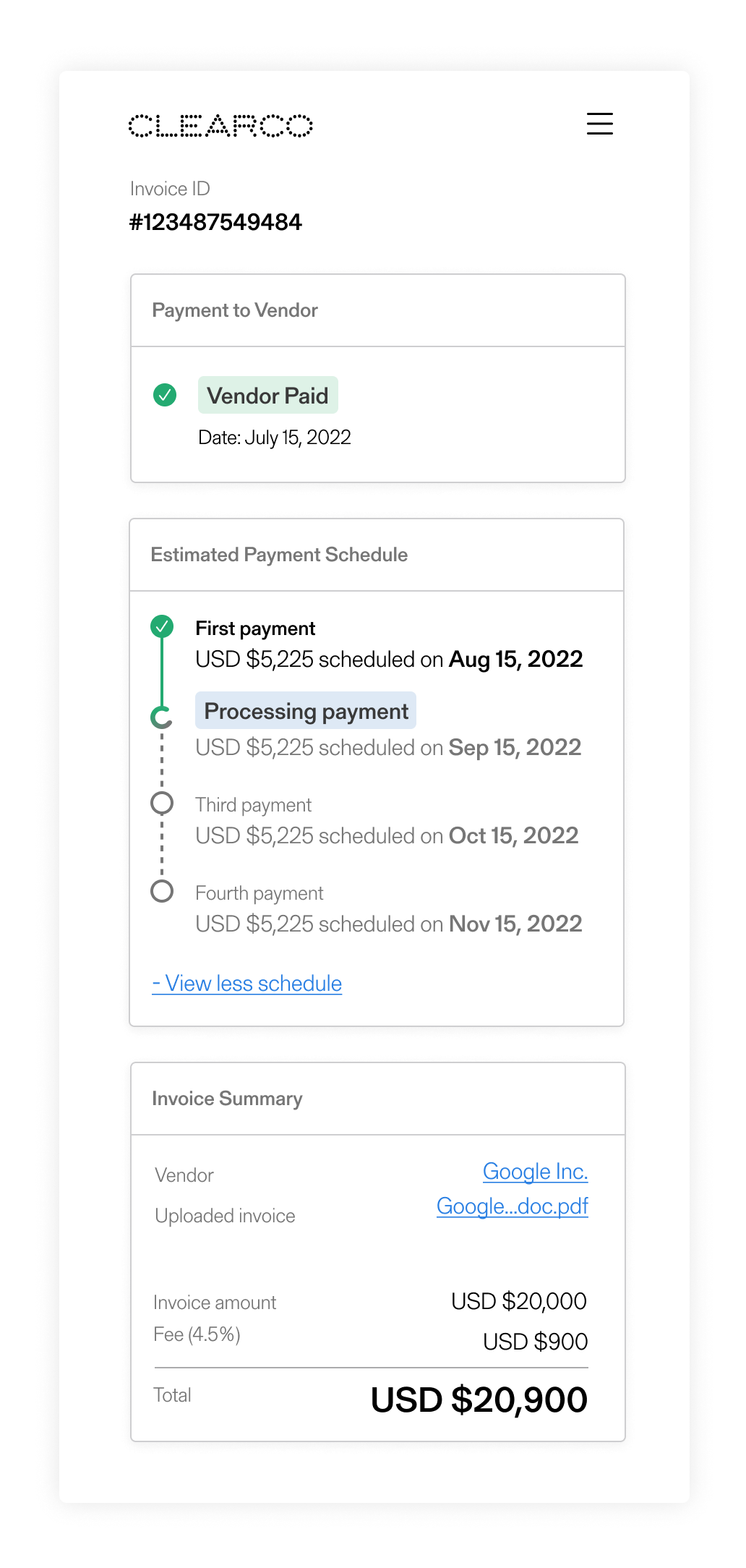
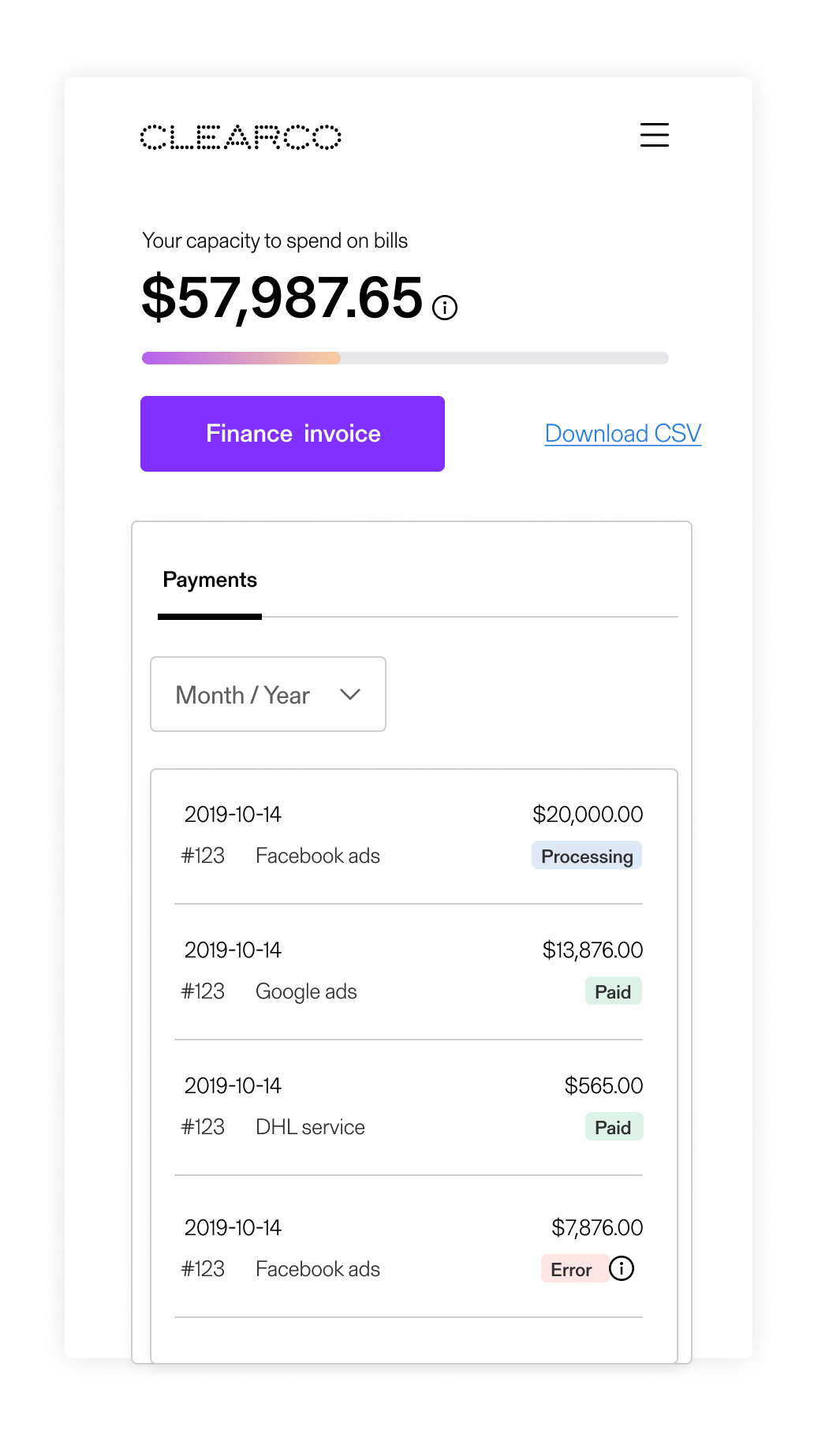
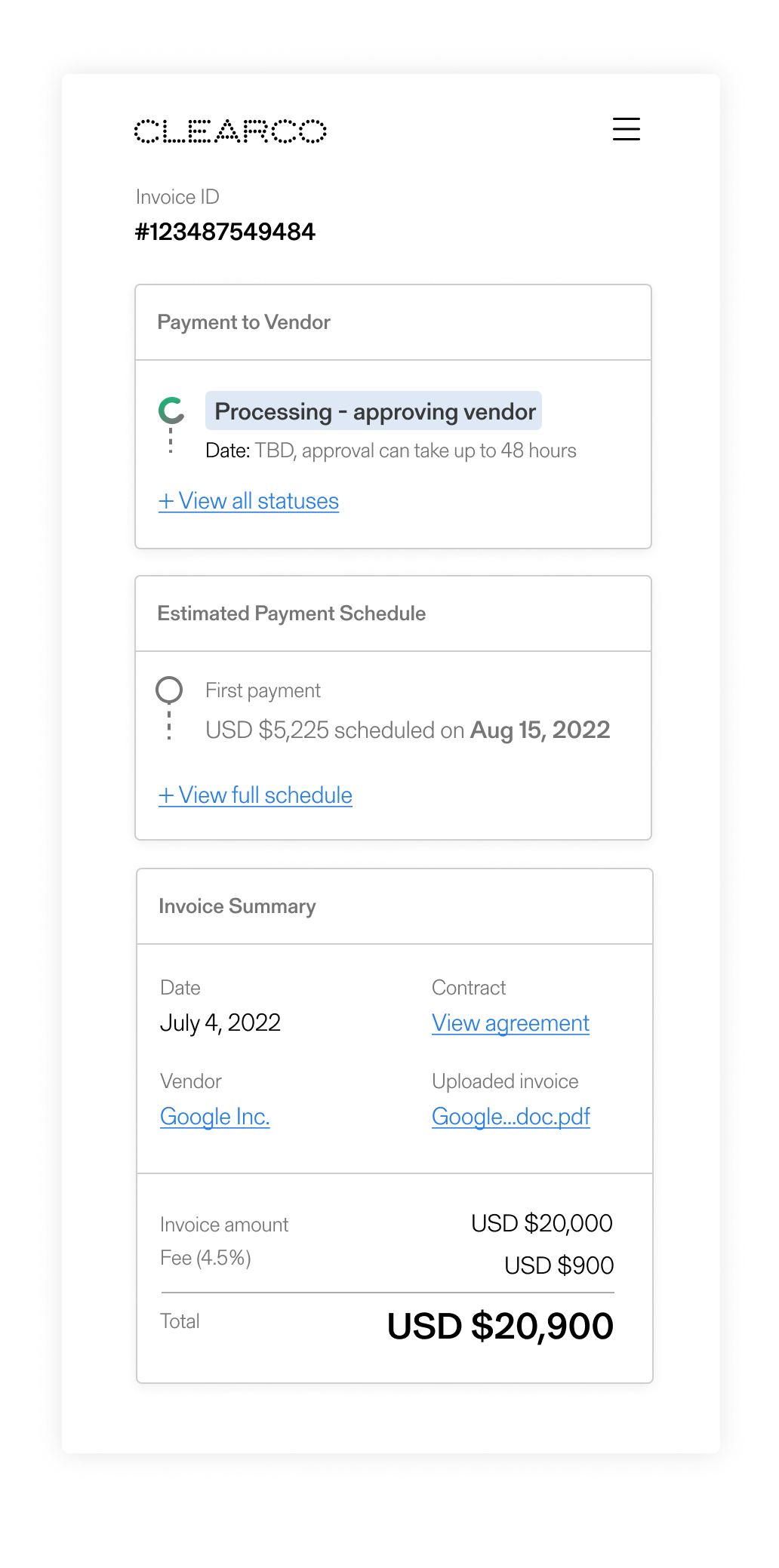
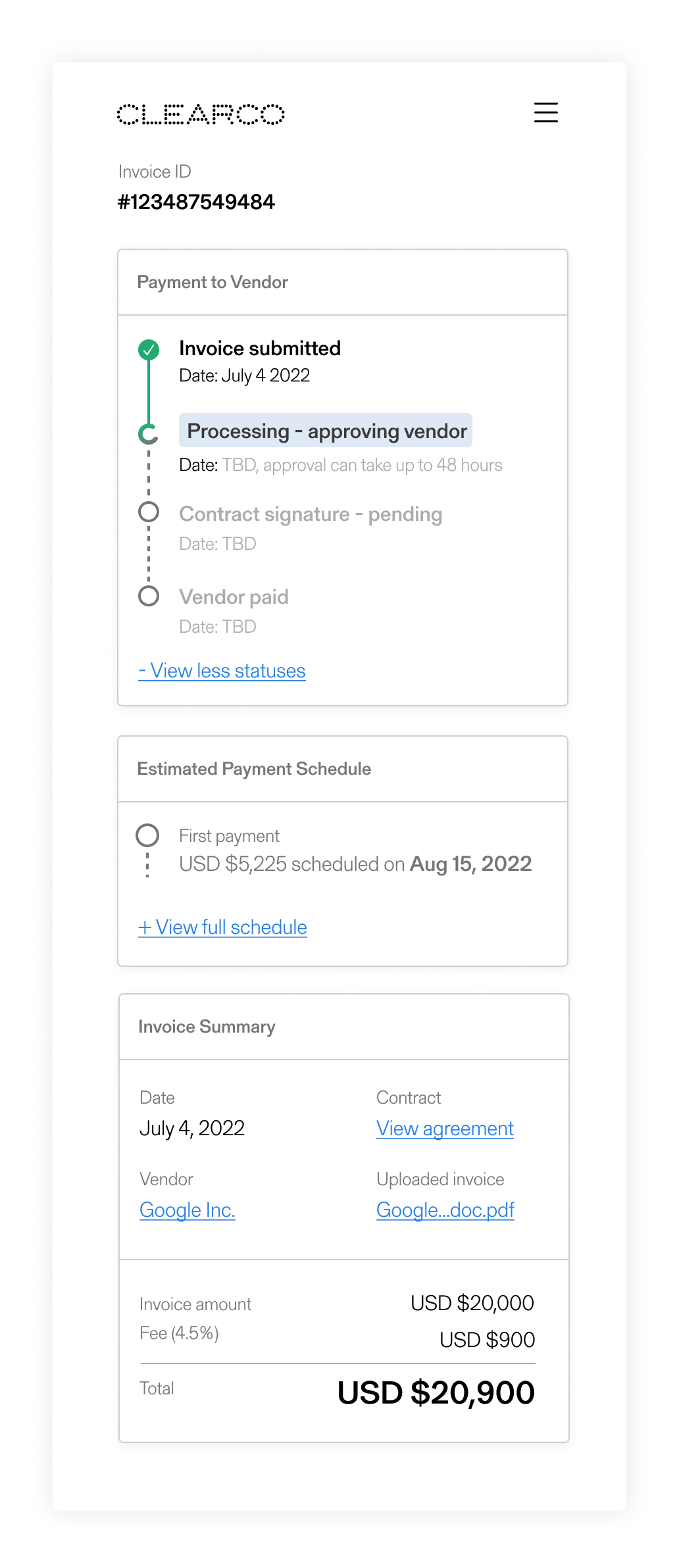
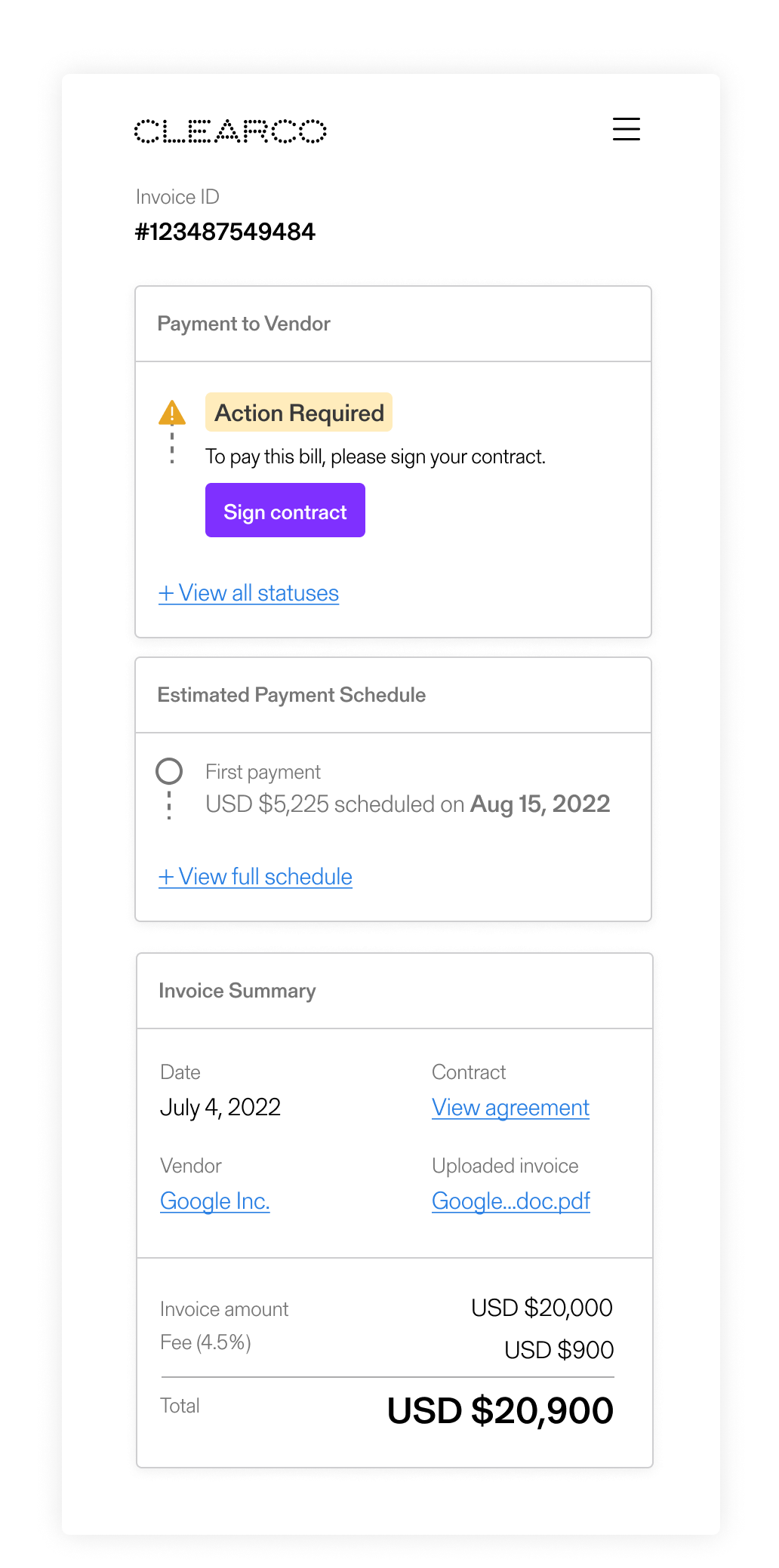
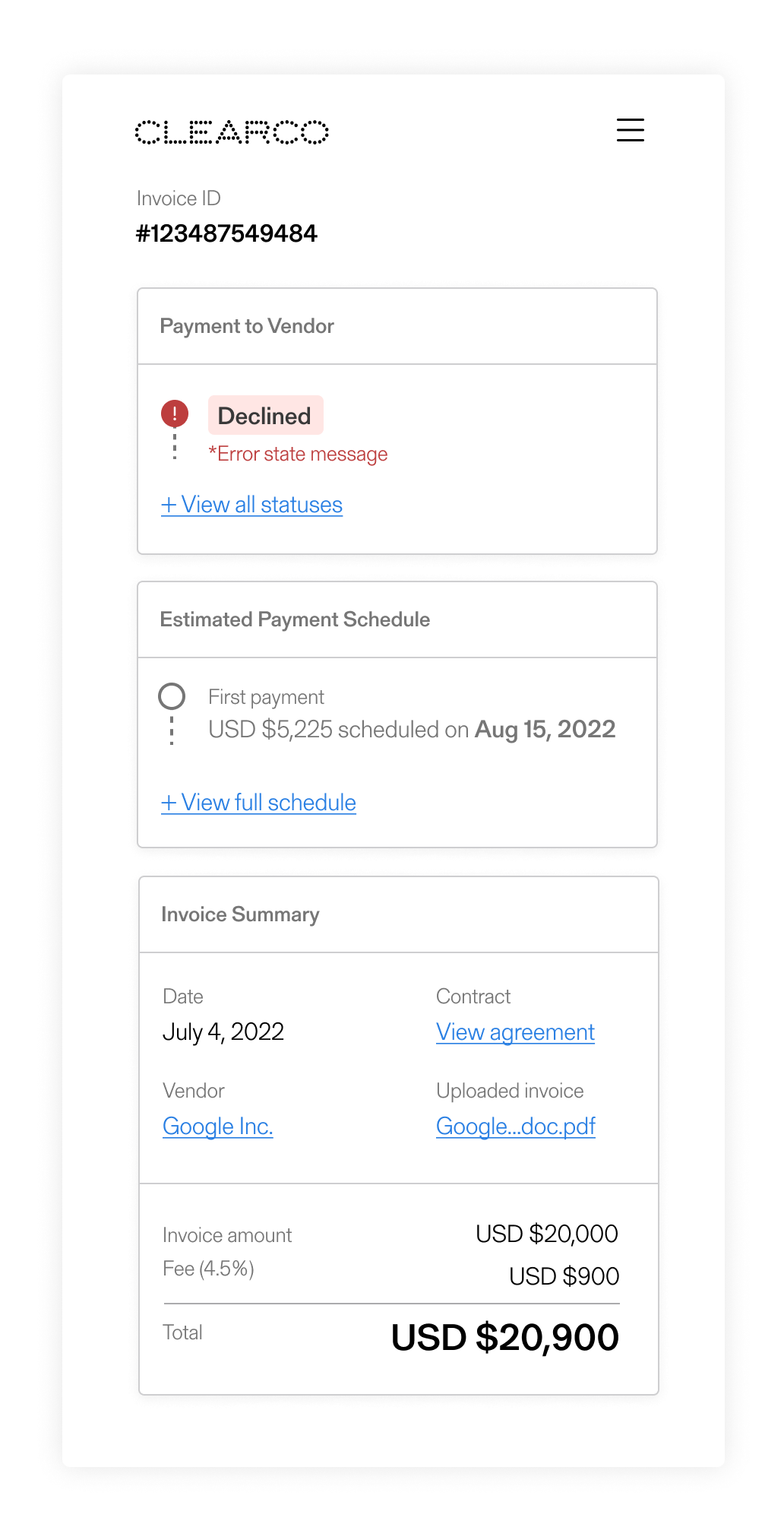
- Build the views for the various transaction detail view pages. When a founder clicks on their bill from the ClearPay index page, they will dive into a detailed view of that page and we want to make sure we have the various components present.
- Speed over completeness as our developers are going to need to start working on this area pretty quickly.
- Build transparency throughout the process, to reduce friction between the customer & Clearco.
Repayments Transactions
Key Goals & Principles:
- Provide a single ‘debiting’ view. Founders with multiple bills will inevitably be coming back to their dashboard seeking to better plan their cash flows. We want to provided them with the info they need in the most easy way possible and in a way that is ‘compatible’ with their accounting workflows.
- Bubble up items requiring immediate attention. Anything requiring attention/immediate intervention from a Founder should be displayed prominently on their dashboard so that the issue at hand can be acknowledged and resolved in a timely manner. Examples include
- Failed debits
- Disconnected Bank account
- Disconnected Revenue account
- etc.